

Catholic vs. Catholic Lite 2.0:
Why Reformed Theology Never Really Left Rome

Catholic vs. Catholic Lite 2.0:
Why Reformed Theology Never Really Left Rome
Beloved in Christ,
We’re often told the choice is simple:
• Rome – with its tradition, magisterium, and sacraments,
• or the Reformation – with its Bible, grace, and gospel clarity.
But there’s an uncomfortable truth we rarely say out loud:
Much of Reformed / Covenant theology is not a clean break from Catholicism.
It’s Catholicism revised. Catholic Lite. Same foundation, different paint.
If that’s true, then the question isn’t just, “Is Rome wrong?”
It’s also, “How much of Rome did we quietly keep?”
This isn’t about nitpicking labels. It’s about whether we will truly let Scripture set our categories—or keep baptizing an old Augustinian/Catholic blueprint and calling it “biblical.”
⸻
The Shared Basement: Augustine
Both Roman Catholic theology and classic Reformed theology grow from the same root: Augustine. Different branches, same tree.
From Augustine, the Western Church inherits at least three massive structural ideas:
1. A particular view of sin and inability
Not just that we are fallen (which Scripture clearly teaches, Rom. 3:10–18), but that the will is so ruined that regeneration must precede any genuine response. Man must be born again before he can even truly believe.
Scripture presents a different order:
• We are commanded to repent and believe (Mark 1:15; Acts 17:30).
• We are saved through faith (Eph. 2:8–9).
• The Spirit grants new birth to those who believe in Christ (John 1:12–13; John 3:16–18).
2. The Church as the “new Israel”
The people of God across history are flattened into one continuous entity, with Israel’s promises swallowed up and spiritually fulfilled in the Church.
But Paul says:
• “Has God cast away His people? Certainly not!” (Rom. 11:1).
• “Blindness in part has happened to Israel until the fullness of the Gentiles has come in. And so all Israel will be saved…” (Rom. 11:25–26).
There is continuity in salvation (Jew and Gentile in one body, Eph. 2:14–16), but distinction in God’s covenant dealings with Israel and the nations.
3. A “now” kingdom
The Church age is identified with the kingdom and even the millennium; most of the prophetic promises are “realized” spiritually in the present.
Yet the New Testament points us forward:
• We still pray “Your kingdom come” (Matt. 6:10).
• We look for “the world to come” in which we will reign with Christ (Heb. 2:5; Rev. 20:4–6).
• The apostles expected a future restoration for Israel’s kingdom (Acts 1:6–7)—and Jesus did not rebuke the question, only the timing.
Medieval Catholicism builds on this Augustinian blueprint.
The Reformers come along, recover the gospel of grace, but keep the blueprint.
That’s Catholic Lite.
⸻
Where the Catholic DNA Still Shows
1. Israel and the Church Blurred
Covenant Theology is famous for its one Covenant of Grace spanning all of redemptive history. In that model:
• Israel in the Old Testament and the Church in the New are essentially the same covenant people.
• Old Testament promises to Israel are routinely spiritualized and applied to the Church.
• “The Church is the new / true Israel” becomes the default assumption.
But that’s not a Reformation innovation.
That’s Augustine. That’s mainstream Catholic reading.
The New Testament, however, holds a careful, Spirit-breathed tension:
• Yes, there is one people of God in Christ (Gal. 3:28; Eph. 2:11–22).
• No, that does not erase God’s future plans for ethnic / national Israel (Rom. 11:1–2, 11–12, 25–29).
Paul speaks of:
• Israel’s temporary hardening (“in part… until,” Rom. 11:25),
• Israel’s future fullness (“how much more their fullness,” Rom. 11:12),
• and a future salvation of “all Israel” (Rom. 11:26–27), tied to covenant promises.
The prophets echo this with concrete language—land, city, throne, nation (Jer. 31:35–37; Ezek. 36–37; Zech. 14)—not vague church-age metaphors.
When you inherit Augustine’s “Church = Israel” equation, you also inherit his hermeneutic:
• You start needing to allegorize, spiritualize, and flatten out prophetic texts so they’ll fit your grid.
• “Israel” becomes “the Church.”
• “Land” becomes “heaven.”
• “Throne of David” becomes a generic “reign in our hearts.”
Change the wallpaper all you want—if that wall is crooked, you will feel it everywhere.
⸻
2. Sacraments Built on a Faulty Map
If the Church simply continues or absorbs Israel, then it feels logical to say:
Circumcision in the Old Testament
↔ infant baptism in the New Testament
…as parallel covenant signs marking the community.
That’s exactly the move both Catholic and Reformed systems make:
• Rome, inside a sacramental economy of grace.
• Reformed, inside a covenantal framework of the “one people of God.”
Different language, same map.
But what does the New Covenant actually look like?
“Behold, the days are coming… when I will make a new covenant with the house of Israel and with the house of Judah…
I will put My law in their minds, and write it on their hearts…
They all shall know Me, from the least of them to the greatest of them.”
(Jer. 31:31–34, echoed in Heb. 8:8–12)
Every member of the New Covenant:
• Has God’s law written on the heart.
• Knows the Lord.
• Has sins forgiven.
That is not a mixed community of believer and unbeliever bound together by ritual. That is a born-again people (John 3:3–7; Heb. 10:15–18).
When you actually watch the New Testament church in action, what do you see?
• Those who received the word were baptized (Acts 2:41).
• “When they believed… both men and women were baptized” (Acts 8:12).
• The Ethiopian eunuch: “What hinders me from being baptized?… ‘If you believe with all your heart, you may’” (Acts 8:36–37).
Faith, then baptism. Conversion, then sign. Not birth, then ritual, and “we’ll see later if they’re really in.”
Infant baptism as a covenant sign for a mixed community (believer and unbeliever alike) is not just a “denominational quirk.” It is a direct consequence of the underlying Catholic/Augustinian map:
• Church = Israel
• Circumcision = baptism
• Covenant = visible community, regardless of personal faith
Again: Catholic vs. Catholic Lite.
⸻
3. An Inherited Eschatology
Reformed amillennialism didn’t begin with Calvin. It began with Augustine, who reframed the “thousand years” (Rev. 20) as the present Church age.
Rome embraced that. So did much of the Reformation.
But Revelation 20 actually says:
• Satan will be bound “a thousand years” (Rev. 20:2–3).
• The martyrs “lived and reigned with Christ for a thousand years” (Rev. 20:4).
• “The rest of the dead did not live again until the thousand years were finished” (Rev. 20:5).
That’s a real sequence:
binding → millennial reign → release → final rebellion → final judgment.
The prophets align with a future, earthly kingdom centered on Israel:
• The nations streaming to Jerusalem to learn God’s law (Isa. 2:2–4).
• A righteous reign of Messiah over a restored creation (Isa. 11).
• The LORD reigning as King over all the earth from Jerusalem (Zech. 14:9–11, 16–17).
• Gabriel promising Mary that her Son will sit on “the throne of His father David” and “reign over the house of Jacob forever” (Luke 1:32–33).
Recast all of that as “symbolic of the present church age,” and you have effectively Augustinized your eschatology.
The fallout:
• Promises of land, throne, and nation to Israel get spiritualized.
• The hope of a real, future, earthly reign of Christ becomes vague or purely symbolic.
• Prophetic writings are bent to fit an already-chosen system.
At that point we’re not looking at a “Bible versus Rome” showdown.
We’re looking at two teams running the same playbook with different jerseys.
Catholic. Catholic Lite.
⸻
The Reformation Fixed the Gospel, Not the Blueprint
I thank God that the Reformers stood up to Rome on:
• Justification by faith alone (Rom. 3:21–28; 4:4–5).
• Christ as the only Mediator (1 Tim. 2:5).
• Scripture over tradition (Mark 7:6–13; Acts 17:11).
But that’s precisely why this matters so much.
The gospel of grace was recovered inside a largely unchanged Augustinian-Catholic framework.
The Reformers corrected the content of salvation—how a sinner is made right before God—but left much of the architectural framework of theology sitting on the same old foundation:
• Israel and the Church
• Sacraments and covenant signs
• The nature of the kingdom
• The shape of our hope and eschatology
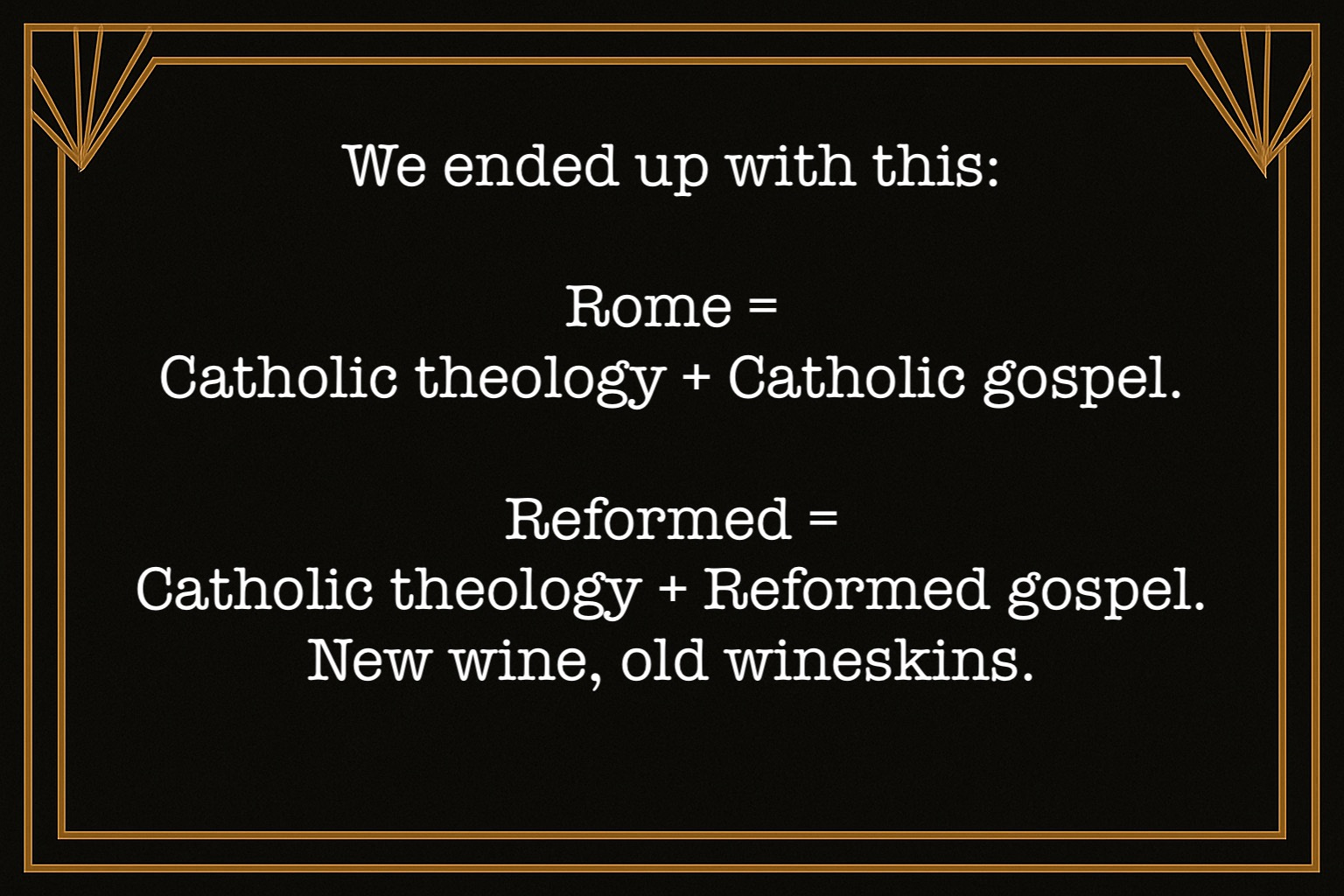
The result looks something like this:
• Rome: Catholic theology + Catholic gospel (sacramental, infused righteousness)
• Reformed: Catholic theology + Reformed gospel (imputed righteousness, by faith alone)
New wine, old wineskins (Matt. 9:16–17).
And sometimes, even the “Reformed gospel” gets pulled back toward Rome by the system around it:
• A God who supposedly decrees all sin yet punishes man for what he cannot avoid.
• An atonement that is “sufficient for all, efficient for the elect” but functionally preached as “Christ did not really die for you unless you’re elect.”
• A view of “sovereignty” that ends up sounding very much like fatalism with Bible verses.
At some point you have to ask:
Is this really the freedom and clarity of the New Testament, or just another heavy system dressed in Reformation language?
⸻
Why This Isn’t Just Theological Trivia
“Okay, but does this really matter for everyday discipleship?”
It absolutely does.
• Scripture-reading gets hijacked.
If Israel and the Church are blurred, your reading of massive portions of Scripture is shaped more by Augustine and Calvin than by the actual words on the page. You lose the straightforward sense of the promises and prophecies, and everything becomes a code to decode.
• Grace gets tangled up with structures.
If you inherit a sacramental/covenantal structure built on a faulty map, you will constantly fight to keep grace and ritual in their proper place. You tell people “salvation is by grace through faith,” but the system keeps pulling them back toward performance, sacraments, and belonging to the “right” covenant community.
• Hope gets shrunk.
If your eschatology is basically medieval, your horizon for what God is doing with Israel, the nations, and the kingdom is clouded. “The blessed hope” (Titus 2:13) gets flattened into “things just continue until Jesus shows up at the end,” instead of a living expectation of His coming, His reign, and the fulfillment of His promises to Israel and the world.
• People get crushed.
A system that tells you God unconditionally decreed every evil—including your abuse, your trauma, your loved ones’ unbelief—and then blames you for struggling under that load, does real damage. That’s not the heart of the Father Jesus reveals (Matt. 11:28–30; John 3:16–17; 2 Pet. 3:9).
This is not about scoring points against Catholics or Calvinists.
It’s about asking a brutally honest question:
Have we really let Scripture rebuild our categories,
or are we just patching the gospel into an old Catholic framework and calling it “sovereign grace”?
⸻
Back to the Text, Not Back to Rome—or Geneva
My point is not that every Reformed believer is lost.
God saves people in spite of broken systems all the time.
My point is that Reformed systems often rest on Catholic foundations they never actually examined.
If the foundation is cracked, the most polished “doctrines of grace” wallpaper in the world won’t fix it.
So here’s my plea:
• Don’t be content with Catholic vs. Catholic Lite.
• Don’t assume that “Reformed” automatically means “thoroughly biblical.”
• Go back to the text—Genesis to Revelation—and let Scripture, not Augustine, define:
• Israel and the Church (Rom. 9–11; Jer. 30–33; Acts 1:6–7)
• The nature of the New Covenant (Jer. 31:31–34; Heb. 8–10)
• The future of the kingdom (Isa. 2; 11; Zech. 14; Rev. 19–20)
• The shape of our hope (Titus 2:13; 2 Tim. 4:8; 1 Thess. 4:13–18)
The Bereans were called “more noble” because they searched the Scriptures daily to see whether even Paul’s teaching was so (Acts 17:11). That’s the spirit we need now—not blind loyalty to Rome, or to Geneva, or to any modern tribe.
The Reformation was a start, not a finish line.
If we really believe in sola Scriptura, then we must be willing to let the Bible challenge not only Rome, but also Reformed theology itself—and every one of our beloved systems that still quietly rests on Catholic ground.
Postscript to the Reformed Reader
If you’ve read this far and you’d call yourself “Reformed,” let me say this plainly: I’m not attacking your intelligence or your sincerity. I am attacking a system that I believe has lied to you, weighed you down, and taught you to trust a framework more than the plain sense of Scripture.
If sola Scriptura really means anything, then it has to mean this:
• Augustine is not untouchable.
• Calvin and the Confessions are not untouchable.
• Your favorite preacher is not untouchable.
Only the Word of God is.
So here is my challenge to you:
• Take a clean Bible.
• Lay your system on the table.
• Read Romans 9–11, Jeremiah 30–33, Ezekiel 36–37, Revelation 19–20, Acts 1, and the New Covenant passages (Jer. 31; Heb. 8–10) with fresh eyes.
Every time you feel, “That can’t mean what it says, because my system says…” — stop.
Ask: Who is really in charge here? The text, or my tradition?
The Bereans were called “more noble” not because they picked the right camp, but because they searched the Scriptures to see whether even Paul was right (Acts 17:11).
I’m asking you to do the same.
Don’t do it for me. Don’t do it to win an argument.
Do it because, if Christ is Lord, then His Word gets the last word—even over the theology you’ve loved the most.
This is brilliant in its simplicity. And simple in its depth
Well thought out.
My Catholic friends would share my view. I certainly like to focus on the majors not the minors.
Catholic divergences: Downplays Rome’s additions (Mariology, papal infallibility) not shared by Reformed.
Historical context: Skips how Augustine influenced all Western theology, including Eastern Orthodox; Reformers engaged/critiqued him selectively.
Diverse Reformed views: No mention of premillennial Reformed (e.g., MacArthur) or dispensational influences within evangelicalism.
Positive Reformed contributions: Ignores TULIP’s biblical basis (e.g., Rom. 9 on election) and sola scriptura’s full application in confessional documents.
Amillennialism as non-biblical: Rev. 20 “thousand years” as sequence ignores symbolic genre (e.g., Psalm 50:10); Reformed amillennialism aligns with apostolic expectation (1 Cor. 15:23–28), not just Augustine.
• Infant baptism as Catholic holdover: Parallels circumcision/baptism valid in covenant theology (Col. 2:11–12); Acts examples (2:39, household baptisms) support mixed communities, not solely credobaptist.
Reformation kept “Catholic blueprint”: Overstates; Reformers rejected papal authority, transubstantiation, purgatory, indulgences—core breaks beyond “gospel content.”
Thank you for your work.