

Chapter Three
The Chain of Custody

Chapter Three
Before the Legends Could Grow
The Historical Case for the Early New Testament and the Reliability of Scripture
By Robert Rousseau
Candlefish Ministries | John 1:5
“For I delivered to you first of all that which I also received…”
—1 Corinthians 15:3 (NKJV)
⸻
Every Great Investigation Begins Here
Imagine a detective standing in a courtroom holding a critical piece of evidence.
The first question is rarely, “What is it?”
The first question is:
“Where did it come from?”
Who discovered it?
Who handled it?
Who preserved it?
Has it been altered?
Can its history be traced?
In criminal law, this is called the chain of custody.
Without it, even genuine evidence can be challenged.
Remarkably, Christianity possesses something very much like a historical chain of custody.
Not for an object.
For a message.
The Gospel itself.
How do we know the message preached by Paul was the same message proclaimed by Peter?
How do we know the churches of Corinth, Ephesus, Philippi, and Rome were hearing the same Gospel that had first been preached in Jerusalem?
The answer begins with one of the oldest Christian texts preserved anywhere in the New Testament.
“I Received… I Delivered…”
Writing to the church in Corinth around the mid-50s, Paul reminds believers of the Gospel he had already preached to them.
He writes:
“For I delivered to you first of all that which I also received: that Christ died for our sins according to the Scriptures, and that He was buried, and that He rose again the third day according to the Scriptures, and that He was seen by Cephas, then by the twelve.”
—1 Corinthians 15:3–5 (NKJV)
Those two verbs deserve careful attention.
Received.
Delivered.
Paul is not presenting a new theological insight.
He is passing along something that had already been entrusted to him.
The language belongs to the vocabulary of Jewish tradition.
Rabbis received teaching.
They delivered teaching.
Students memorized it.
Communities preserved it.
The emphasis is not originality.
It is faithful transmission.
Paul is saying, in effect,
“This isn’t my Gospel.
I received it.
Now I am handing it to you.”
Older Than First Corinthians
This is where the argument becomes fascinating.
Nearly every scholar recognizes that Paul is quoting material older than the letter itself.
Whether one dates the creed only a few years after the crucifixion or somewhat later, the point remains the same:
The core proclamation of Christianity predates Paul’s letter.
Think about what that means.
Before 1 Corinthians existed…
Before Romans…
Before Philippians…
Before most—or perhaps all—of the New Testament books…
Christians were already proclaiming:
Christ died.
Christ was buried.
Christ rose.
Christ appeared.
The Gospel did not gradually emerge over generations.
It already existed.
The Heart of the Gospel
Notice what Paul includes.
He does not begin with ethical teaching.
He does not begin with church organization.
He does not begin with philosophy.
He begins with historical events.
Christ died.
Christ was buried.
Christ rose.
Christ appeared.
Christianity rests upon things God did in history.
The Gospel is not primarily advice.
It is news.
Good news.
Something happened.
And because it happened…
everything changed.
According to the Scriptures
Twice Paul repeats an important phrase.
“According to the Scriptures.”
The death of Christ was not an unexpected tragedy.
The resurrection was not an improvised solution.
Both stood within the framework of God’s redemptive plan already revealed in the Old Testament.
Christianity did not abandon Israel’s Scriptures.
It proclaimed their fulfillment.
From its earliest days the Church understood Jesus through Moses, David, Isaiah, Daniel, Zechariah, and the Prophets.
The Gospel did not appear disconnected from biblical history.
It completed it.
The Witnesses Have Names
One feature of this early creed deserves special attention.
It names people.
Cephas.
The Twelve.
James.
More than five hundred brethren.
All the apostles.
Finally…
Paul himself.
Ancient myths rarely anchor themselves this way.
They prefer distant heroes.
Unnamed crowds.
Undefined places.
The Gospel does the opposite.
It repeatedly ties itself to identifiable witnesses.
These are people the earliest Christians knew.
People with families.
Homes.
Reputations.
Histories.
Christianity never asks readers to believe because “someone somewhere once said.”
It repeatedly points toward people.
Real people.
The Five Hundred
Paul continues:
“After that He was seen by over five hundred brethren at once, of whom the greater part remain to the present, but some have fallen asleep.”
This sentence is astonishing.
Paul assumes many witnesses remain alive.
He does not hide behind the passing of time.
He points directly toward living testimony.
Imagine writing this if it were false.
The churches of Corinth had relationships throughout the eastern Mediterranean.
Travel was common.
Letters circulated.
Missionaries moved continually.
Paul’s statement invites investigation.
“Many are still alive.”
In effect he says,
“You can ask them.”
Legends seldom encourage that.
Paul Was Not the Beginning
Modern readers sometimes imagine Paul inventing Christianity.
Nothing could be farther from the truth.
Paul repeatedly insists that he inherited the Gospel.
He received it.
He proclaimed it.
He defended it.
He suffered for it.
But he did not create it.
Christianity existed before Paul became a Christian.
The churches existed before Paul planted churches.
The apostles preached before Paul preached.
The resurrection was proclaimed before Paul ever met Christ on the Damascus Road.
This completely overturns the popular picture of Paul as Christianity’s true founder.
He was not the architect.
He was its greatest missionary.
Then Paul Met Peter
Even more remarkable…
Paul eventually traveled to Jerusalem.
There he writes:
“Then after three years I went up to Jerusalem to see Peter, and remained with him fifteen days. But I saw none of the other apostles except James, the Lord’s brother.”
Galatians 1:18–19
Pause and consider what this means.
Within only a few years of his conversion…
Paul spends over two weeks with Peter.
Not merely greeting him.
Living with him.
Talking with him.
Learning from him.
The Greek verb Paul uses carries the sense of becoming personally acquainted.
Who better to ask about Jesus than the man who had walked beside Him for three years?
Who better to discuss the resurrection than one who claimed to have seen the risen Christ?
Paul’s Gospel was not developing in isolation.
It stood face-to-face with the original witnesses.
Then Came James
Paul also met James.
Not James the son of Zebedee.
James…
the brother of Jesus.
Think about that.
If Christianity were inventing stories about Jesus…
His own family remained in Jerusalem.
James was hardly an easy convert.
During Jesus’ earthly ministry, the Gospels tell us His brothers did not yet believe in Him (John 7:5).
Something changed.
Dramatically.
The skeptic must explain that transformation.
The New Testament offers an answer.
The risen Christ appeared to James.
Whatever conclusion one reaches, James became one of the principal leaders of the Jerusalem church.
Paul knew him personally.
The Gospel Was Examined
Years later Paul returned to Jerusalem.
This time he met with:
James.
Peter.
John.
The recognized pillars of the Church.
He presented the Gospel he preached among the Gentiles.
What happened?
Paul tells us.
They added nothing.
Instead, they recognized that God had entrusted Paul with the Gospel for the Gentiles just as Peter had been entrusted with the Gospel for the Jews.
There were not two Christianities.
There was one.
One Lord.
One Gospel.
One resurrection.
One Christ.
The Chain of Custody
Think again about the courtroom.
The evidence passes from hand to hand.
Each transfer is known.
Each link is visible.
Now consider the Gospel.
Jesus.
↓
Peter.
↓
James.
↓
John.
↓
Paul.
↓
The churches across the Roman Empire.
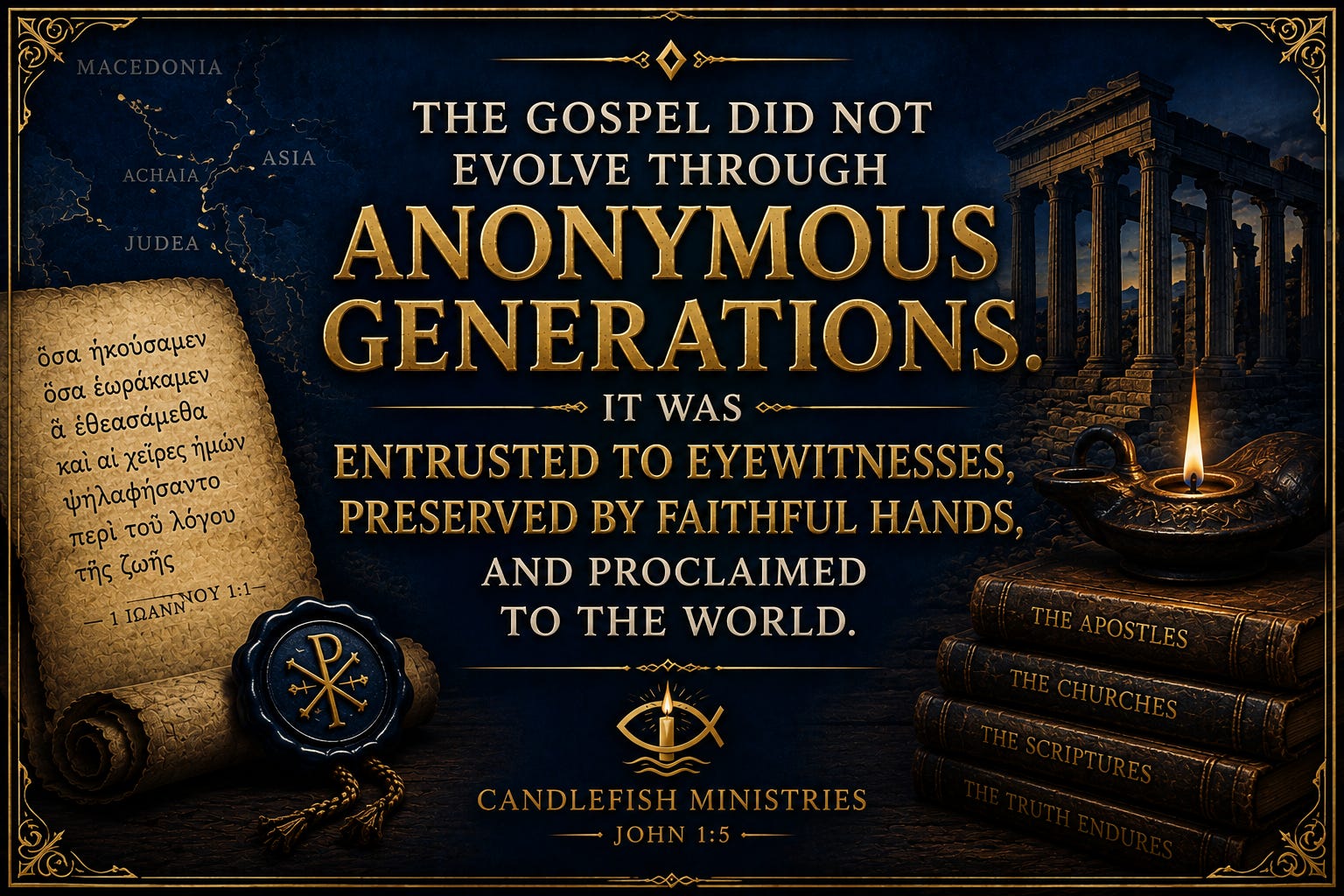
This is not anonymous folklore.
This is not centuries of uncontrolled storytelling.
It is a remarkably short chain.
A chain still connected to the original witnesses.
A Dangerous Message
One final observation.
The earliest Christians gained almost nothing by proclaiming this message.
They did not become wealthy.
They did not gain political power.
Many lost their homes.
Their reputations.
Their freedom.
Some lost their lives.
One may question whether they were correct.
One cannot easily argue they invented the story because it benefited them.
The chain of custody was preserved at enormous personal cost.
People rarely die for what they know to be a deliberate fabrication.
Looking Ahead
The chain of custody raises an obvious question.
If the Gospel was already fixed…
If Paul received it…
If Peter preached it…
If James affirmed it…
What exactly did that earliest Gospel say about Jesus?
Was He merely an inspired teacher?
A prophet?
A political Messiah?
Or did the earliest Christians already proclaim something far more astonishing?
The answer surprises many readers.
The highest view of Christ did not emerge centuries later.
It was already there.
Waiting for us in the earliest Christian writings.
Next Chapter
Chapter Four: A Gospel Already Fully Formed
Long before church councils, long before the canon was finalized, and long before Christianity became legal, believers were already worshiping Jesus as Lord. The evidence points not to a gradually evolving Christ, but to a fully proclaimed one from the very beginning.
Yes Robert and Praise the Lord for His majestic mercy and grace❣️🙏AMEN and HALLELUJAH, AMEN‼️🎉❤️✝️💖🙏😻
Morning y’all,
From Son To Savior! Hallelujah!
Thank you Robert for teaching the truth of the gospel and for sharing your marvelous gift of the written word. I found it powerful and inspiring and can’t wait for the next chapter. Bless The Lord!
Be Encouraged! His Truth Still Marches On! Until next time.
Keep Praising The Lion Of Judah! 😇