

Chapter Two
The First Generation

Chapter Two
The First Generation
Before the Legends Could Grow
The Historical Case for the Early New Testament and the Reliability of Scripture
By Robert Rousseau
Candlefish Ministries | John 1:5
“…that which we have heard, which we have seen with our eyes, which we have looked upon, and our hands have handled, concerning the Word of life…”
—1 John 1:1 (NKJV)
History Lives or Dies by Proximity
One of the first questions every historian asks is remarkably simple:
How close is the source to the event?
A diary written during World War II carries more historical weight than a novel written five hundred years later.
A courtroom witness who actually saw the crime is generally more valuable than someone repeating stories decades afterward.
Proximity matters.
Time matters.
Eyewitnesses matter.
This principle applies to every historical investigation—including Christianity.
If the New Testament appeared centuries after Jesus, then the legend theory becomes plausible.
But if its central message arose immediately, while eyewitnesses were still alive, then the theory begins to collapse under its own weight.
The evidence points overwhelmingly toward the second conclusion.
Christianity Was Born in the Open
The first Christians did something almost unprecedented.
They announced their message publicly in the very city where it could most easily be disproven.
Jerusalem.
The city where Jesus had taught.
The city where He had been arrested.
The city where He had been crucified.
The city where He had been buried.
The city where His followers claimed He had risen from the dead.
If these events were fictional, Jerusalem was the worst possible place to begin preaching them.
The priests were still there.
The Roman officials were still there.
The crowds who had gathered for Passover were still there.
The family of Jesus was still there.
His disciples were still there.
His enemies were still there.
Christianity did not begin in some distant province where no one knew the facts.
It began at the scene of the alleged events.
That matters historically.
The First Sermon
Only weeks after the crucifixion, Peter stood before thousands in Jerusalem.
Listen carefully to what he says.
“Men of Israel, hear these words: Jesus of Nazareth, a Man attested by God to you by miracles, wonders, and signs which God did through Him in your midst, as you yourselves also know.”
Acts 2:22
Peter appeals to shared public knowledge.
He assumes his audience already knows who Jesus was.
He assumes they know where He ministered.
He assumes they know the controversy surrounding Him.
He even assumes they know about His miracles.
Whether every person believed those miracles came from God is another matter.
The point is that Jesus was already a public figure.
Christianity did not begin by introducing an unknown hero.
It proclaimed someone whose life had already become a matter of public discussion.
The Earliest Christians Were Eyewitnesses
Modern discussions sometimes speak of “the early church” as though it were several generations removed from Jesus.
The New Testament presents a very different picture.
Peter was there.
John was there.
Matthew was there.
The women who discovered the empty tomb were there.
James, the brother of Jesus, was there.
The apostles were not writing about events that happened long before they were born.
They were writing about events that had transformed their own lives.
John opens his first epistle with extraordinary language:
“That which was from the beginning, which we have heard, which we have seen with our eyes, which we have looked upon, and our hands have handled, concerning the Word of life…”
1 John 1:1
Notice the repeated emphasis.
We heard.
We saw.
We looked.
We touched.
John is not offering philosophy.
He is claiming experience.
Whether one accepts his testimony is another question.
But there can be little doubt about what he intends to communicate.
He presents himself as an eyewitness.
A Faith Rooted in Memory
The earliest Christian movement depended upon living memory.
The apostles did not simply preach ideas.
They told stories.
Stories about conversations.
Meals.
Journeys.
Healings.
Storms.
Crosses.
An empty tomb.
Resurrection appearances.
Those stories were repeated in churches while the people who had experienced them were still alive.
That changes everything.
Imagine someone standing in Jerusalem around AD 35 claiming:
“I was there when Jesus fed the five thousand.”
Another replies,
“So was I.”
That is not mythology.
That is living memory.
Legends flourish when memories disappear.
Christianity arose while memories remained.
The Family of Jesus
One fact often overlooked is the continued presence of Jesus’ own family.
James, the Lord’s brother, became one of the leaders of the Jerusalem church.
Paul later met him personally.
Could someone invent extraordinary stories about Jesus while His own family remained in Jerusalem?
Of course, families can disagree.
But families are also remarkably good at correcting falsehoods.
If Jesus had never claimed extraordinary things…
If He had never performed remarkable deeds…
If His followers had invented entirely new stories about Him…
His own relatives would have been uniquely positioned to expose those inventions.
Instead, James himself became one of Christianity’s leading figures.
The skeptic must explain not only the disciples…
but the family.
The Five Hundred
Perhaps no passage illustrates the closeness of the evidence more vividly than Paul’s famous summary in First Corinthians.
After listing Jesus’ appearances, Paul writes:
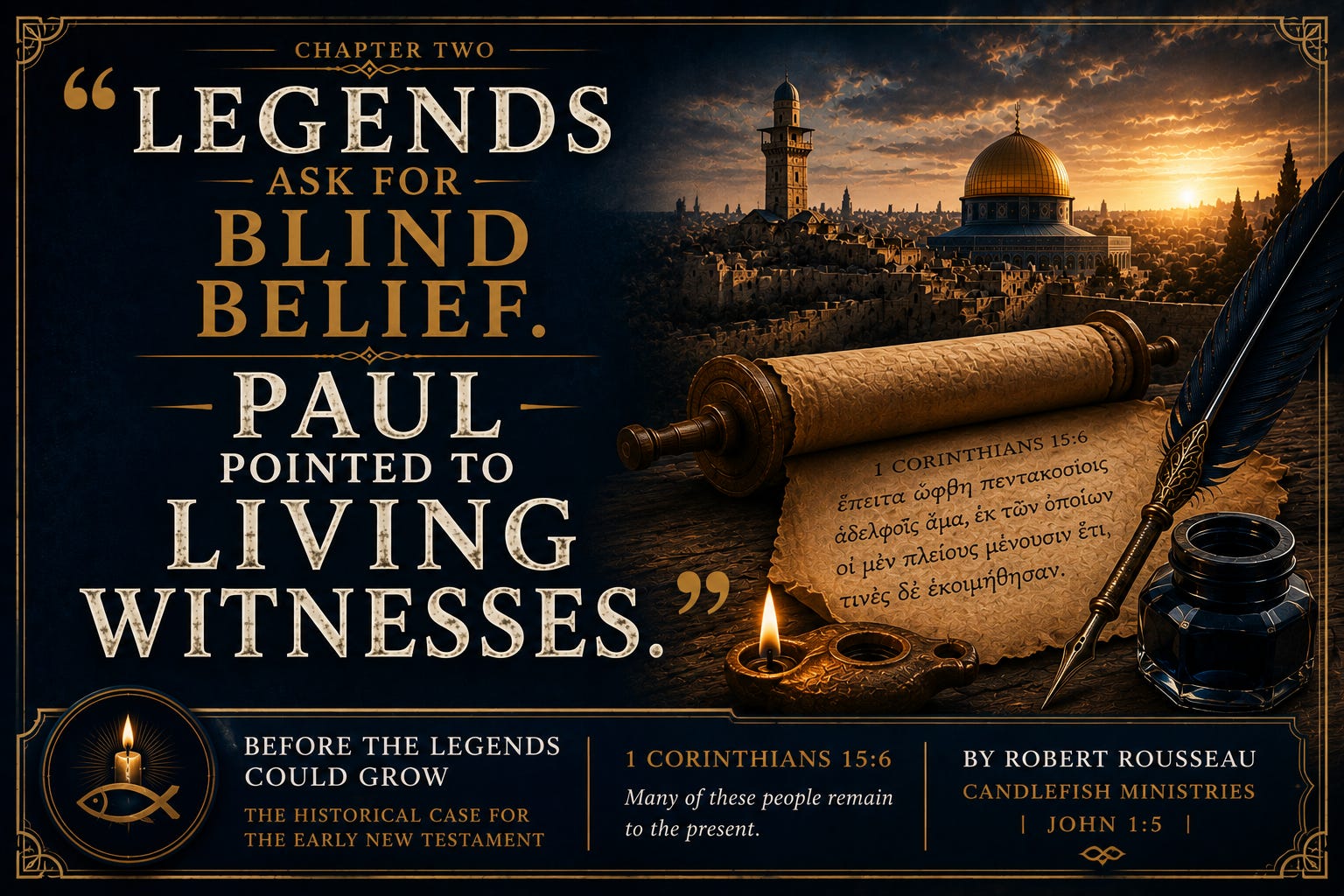
“After that He was seen by over five hundred brethren at once, of whom the greater part remain to the present, but some have fallen asleep.”
1 Corinthians 15:6
This is a remarkable historical statement.
Paul does not simply claim that Jesus appeared.
He reminds his readers that many eyewitnesses remain alive.
In effect he says:
“Many of these people are still here.”
That is a dangerous statement if it is false.
It invites investigation.
It invites conversation.
It invites verification.
Legends do not normally encourage readers to interview living witnesses.
A Generation Is Not Enough
Critics often speak about “oral tradition” as though oral transmission automatically produces legendary material.
History tells a more nuanced story.
Ancient Jewish culture was remarkably disciplined in preserving important teaching.
Rabbis trained disciples to memorize.
Students learned through repetition.
Sacred traditions were carefully guarded.
Even apart from this cultural background, the central Christian message did not wander aimlessly for generations.
It was preserved by identifiable people.
Peter.
John.
James.
Paul.
The apostles.
The churches they founded.
The New Testament did not emerge from anonymous folklore.
It emerged from communities led by people who insisted they had personally known Jesus.
The Burden of Explanation
Every historical reconstruction must explain the evidence.
The question is not whether Christianity grew.
Of course it grew.
The question is how.
Did ordinary legends slowly transform a failed teacher into the risen Son of God?
Or did the movement begin because those closest to Jesus genuinely believed He had risen from the dead?
Whatever conclusion one reaches, one fact remains stubbornly in place.
The first generation of Christians stood remarkably close to the events they proclaimed.
The gap between Jesus and the earliest proclamation is measured in years…
not centuries.
That is not what late legend looks like.
Looking Ahead
If the first Christians really stood this close to the events…
then one question naturally follows.
What exactly were they preaching?
Was the Gospel itself slowly developing?
Or was its central message already fixed from the very beginning?
That question leads us directly to one of the most important passages in the entire New Testament.
A short creed.
A few carefully chosen lines.
Words that may carry us within just a handful of years of Calvary itself.
Next Chapter
Chapter Three: The Chain of Custody
How do we know the Gospel preached by Paul was the same Gospel proclaimed by Peter, James, and the earliest eyewitnesses? The answer begins with one of the oldest Christian creeds ever recorded.
Another remarkable thing most do not speak of is the fact that Christ’s Resurrection was so powerful, that MANY saints rose from the dead and made their way into Jerusalem to profess the Gospel.
Matthew 27:51-53 (NASB95) 51 And behold, the veil of the temple was torn in two from top to bottom; and the earth shook and the rocks were split. 52 The tombs were opened, and many bodies of the saints who had fallen asleep were raised; 53 and coming out of the tombs after His resurrection they entered the holy city and appeared to many.
Those individuals, just as Lazarus was raised from the dead, lived to not only die another day, but to proclaim Christ to the world until they did.
Moreover, those individual’s stories had to be impactful, for they had family members who knew of their death and then them being raised. Not only would the individual raised be able to put meat on the bone, but their families who lost and then regained them be able to spread the story of His Resurrection with the upmost integrity and honesty.
Morning y’all,
Thanks Robert! Great preaching Brother. Can’t wait for Chapter Three!
Keep Praising The Lion Of Judah!
He’s Worthy! 😇