

Dispensationalism 101:
God’s Blueprint for the Ages

Dispensationalism 101:
God’s Blueprint for the Ages
Robert Rousseau — Candlefish Ministries John 1:5
“The light shines in the darkness, and the darkness did not comprehend it.” — John 1:5 (NKJV)
A World That Forgot How to Read Its Own Map
Walk into a modern seminary or scroll through Christian social media, and you’ll see it: chaos in interpretation. Prophecy blurred into poetry, Israel replaced by the Church, the future flattened into allegory. The spiritual compass has been demagnetized.
Dispensationalism isn’t a hobbyhorse for chart-makers; it’s the forgotten blueprint of how God has governed human history and revealed His plan of redemption. It restores order where confusion reigns, and it reminds the Church that God means exactly what He says.
What Is a Dispensation?
A dispensation is simply a divine administration—an era in which God entrusts humanity with specific revelation, responsibility, and stewardship. Each period ends the same way: human failure, divine judgment, and fresh grace.
Paul used the word oikonomia (“stewardship” or “administration”) in Ephesians 1:10 and 3:2, describing the “dispensation of the fullness of times.” Dispensationalism isn’t new; it’s embedded in the text.
The Two Anchors of Dispensational Truth
A Literal, Consistent Hermeneutic
We interpret Scripture the way language is meant to work—literally, allowing for symbols where symbols are clearly intended. Every Old-Testament prophecy about Christ’s first coming was fulfilled literally: born in Bethlehem (Micah 5:2), pierced for our transgressions (Isaiah 53:5), risen on the third day (Psalm 16:10).
If the first coming was literal, why would the second be metaphor?A Distinction Between Israel and the Church
God’s covenant promises to Abraham, Isaac, and Jacob were unconditional. The Church has not replaced Israel (Romans 11:1–2). We are grafted in, not graft-replacing. When we blur Israel and the Church, we dismantle the timeline of prophecy itself.
The Seven Dispensations: God’s Story in Order
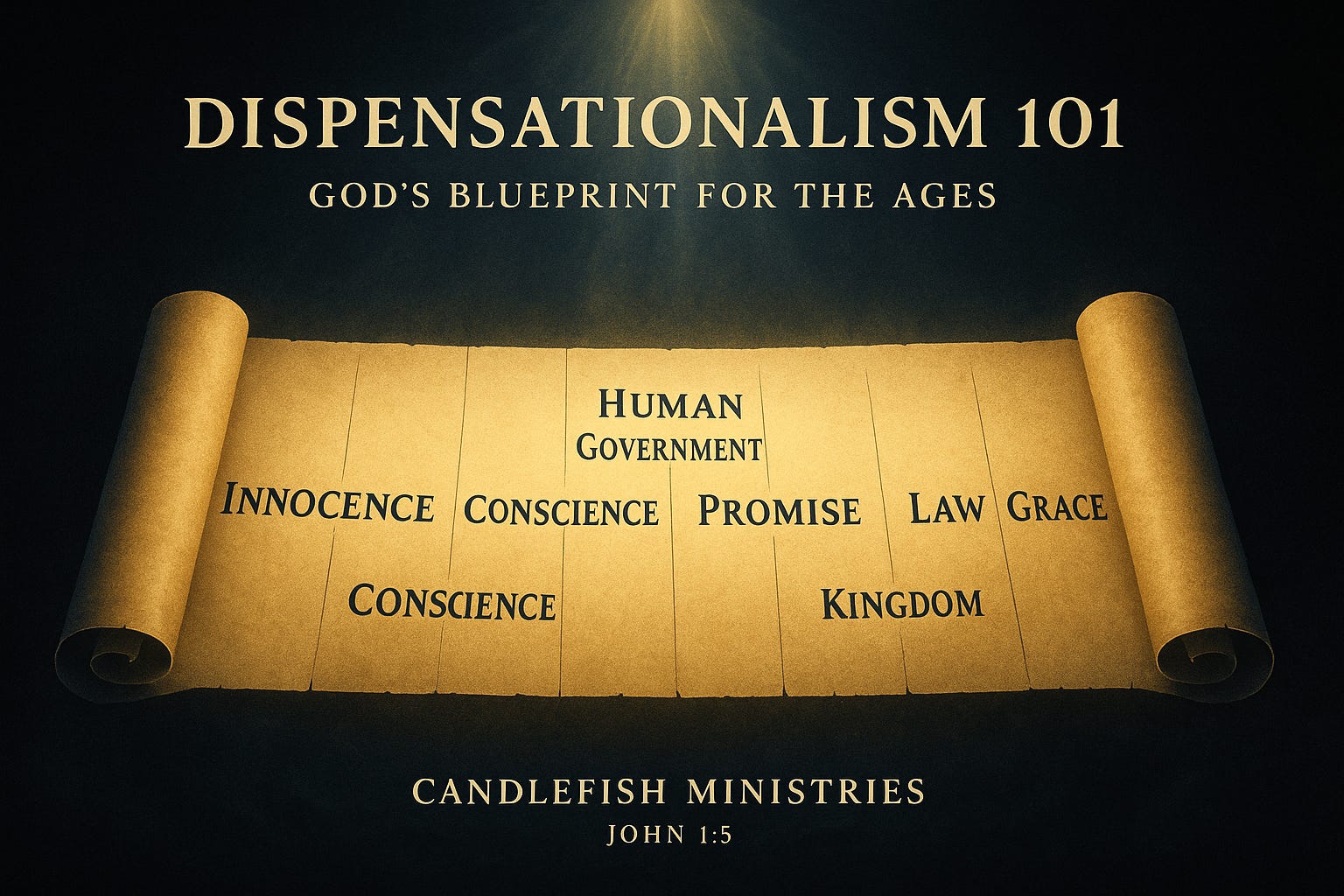
Innocence — Genesis 1–3
Humanity in Eden. The command: “Do not eat.” The failure: disobedience. The judgment: curse and death. Yet grace appears in the promise of the coming Redeemer (Genesis 3:15).Conscience — Genesis 3–8
Guided by conscience, mankind spirals into violence. God judges with the Flood but preserves Noah—a picture of salvation by grace.Human Government — Genesis 9–11
God delegates authority to restrain evil. Babel proves man still rebels. Judgment scatters nations. Grace calls one man, Abram.Promise — Genesis 12–Exodus 19
Abraham is promised land, seed, and blessing. Israel’s bondage in Egypt ends in redemption by blood—a foreshadow of Christ.Law — Exodus 20–Acts 2
God gives Israel His holy standard. The Law exposes sin but cannot save. Grace whispers through the sacrifices pointing to the coming Lamb.Grace (The Church Age) — Acts 2–Revelation 3
The mystery revealed: Jew and Gentile in one Body (Ephesians 3:6). Salvation by grace through faith alone. This age will close with the Rapture of the Church (1 Thessalonians 4:16-17).Kingdom (The Millennium) — Revelation 20
Christ returns with His saints, reigning for a thousand years. Israel’s promises are fulfilled. Satan is bound, then finally destroyed. Eternity follows—new heaven, new earth, unending fellowship with God.
Why Literalism Matters
The moment we abandon literal interpretation, Scripture becomes a mirror for our imagination. Covenant and Roman systems thrive on that elasticity. When “Israel” becomes “the Church,” and “a thousand years” becomes “a long time,” theology becomes politics in ecclesiastical robes.
God doesn’t need editors; He needs believers who still believe words mean what He said.
The Fault Lines: Covenant Theology, Rome, and the New Mystics
Covenant Theology collapses every age into one vague “covenant of grace,” turning the Bible into a monotone.
Roman Catholicism replaces revelation with magisterial control—the chair instead of the Word.
Progressive Evangelicalism spiritualizes prophecy until nothing concrete remains; heaven becomes “now,” and Christ’s reign becomes a metaphor for activism.
Dispensationalism cuts through all of it. It keeps Scripture chronological, not allegorical; prophetic, not plastic.
The Prophetic Blueprint
The Rapture of the Church — 1 Thessalonians 4:16-17
Christ descends to the air; believers are caught up. The restraint of the Spirit (2 Thessalonians 2:7) lifts; global deception rushes in.The Tribulation — Revelation 6–18
Seven years of judgment and mercy intertwined. Israel purified, nations judged, the gospel of the kingdom proclaimed worldwide.The Second Coming — Revelation 19
Heaven opens. The Rider on the white horse returns. We return with Him, clothed in fine linen, not to debate but to reign.The Millennium — Revelation 20
The Kingdom age—the promise to David fulfilled. Peace at last, righteousness enforced, the curse reversed in part.The Eternal State — Revelation 21–22
New heaven, new earth, new Jerusalem. God with His people forever—the ultimate dispensation of grace.
Why the Enemy Hates Dispensationalism
Because it anchors hope in Scripture’s timeline, not man’s institution. It strips the clergy of control and puts prophecy back into the hands of ordinary believers. When you know what God is doing, you can’t be manipulated by what men are saying.
Satan’s oldest lie is “Has God indeed said?” Dispensationalism answers, “Yes—and He meant exactly what He said.”
Living in the Sixth Dispensation: Grace and Urgency
We are the generation standing at the edge of prophetic fulfillment. The Church Age is closing fast. Technology now mirrors Revelation’s warnings; global governance rehearses the Beast system in slow motion.
So what do we do?
Preach the Gospel while there’s time (Romans 10:14).
Watch and stay sober (1 Thessalonians 5:6).
Love the appearing of Christ (2 Timothy 4:8).
Dispensationalism isn’t a chart to argue over; it’s a call to readiness.
The Beauty of the Blueprint
Each dispensation proves the same truth: man fails, God redeems. From Eden’s fall to Calvary’s cross to the Kingdom’s dawn, the pattern is grace woven through judgment. God’s story never changes; His methods unfold with perfect order.
History is not random—it’s revelation in motion.
A Call Back to the Word
The Church doesn’t need new revelation; it needs renewed confidence in the old one. The Bible is not elastic clay for theologians; it’s the fixed Word of the living God.
Every pulpit, every pew, every heart must bend again to that authority. When we do, the fog lifts.
Let There Be Light
Dispensationalism is not arrogance—it’s alignment. It’s seeing God’s plan as He revealed it, not as councils revised it. It is humility before revelation and boldness before the world.
So stand firm in the age of confusion.
Read the Word literally.
Preach Christ urgently.
Wait expectantly.
The blueprint is clear. The light still shines in the darkness—and the darkness has not overcome it.
Robert Rousseau
Candlefish Ministries John 1:5
“The light shines in the darkness, and the darkness did not comprehend it.” — John 1:5 (NKJV)
I am truly grateful to read through this today. So clear to reinforce how I have seen Scripture next to World History so obviously tailored for each season. Hebrews 13:8 affirms that Jesus Christ is the same yesterday, today and forever. And we know that God's Word does not change because it is divinely inspired (1 Timothy 3:15-16). AT THE SAME TIME, just like parents teach and discipline their children differently at different stages of maturity, SO GOD works out His plan of redemption throughout history, step by step, chapter by chapter.
I do take His Word literally except when the symbols are explained by Scripture as symbols, and we can see similes and metaphors used in all intelligent literary works... but I love what this article points out - Dispensational Theology puts CLARITY in the hands of everyday people. God means what He says, and He says what He means. We can count on Him and He is faithful!
Indeed, we’re living in the Church Age (Ephesians 3:2). A time to preach, prepare, and stay alert (1 Thessalonians 5:6). The blueprint is clear. God’s timeline isn’t paused; it’s progressing. And with each passing moment, the call grows louder: live ready, walk in purpose, and don’t delay obedience.