

He Lets Us Hold the Nails

He Lets Us Hold the Nails
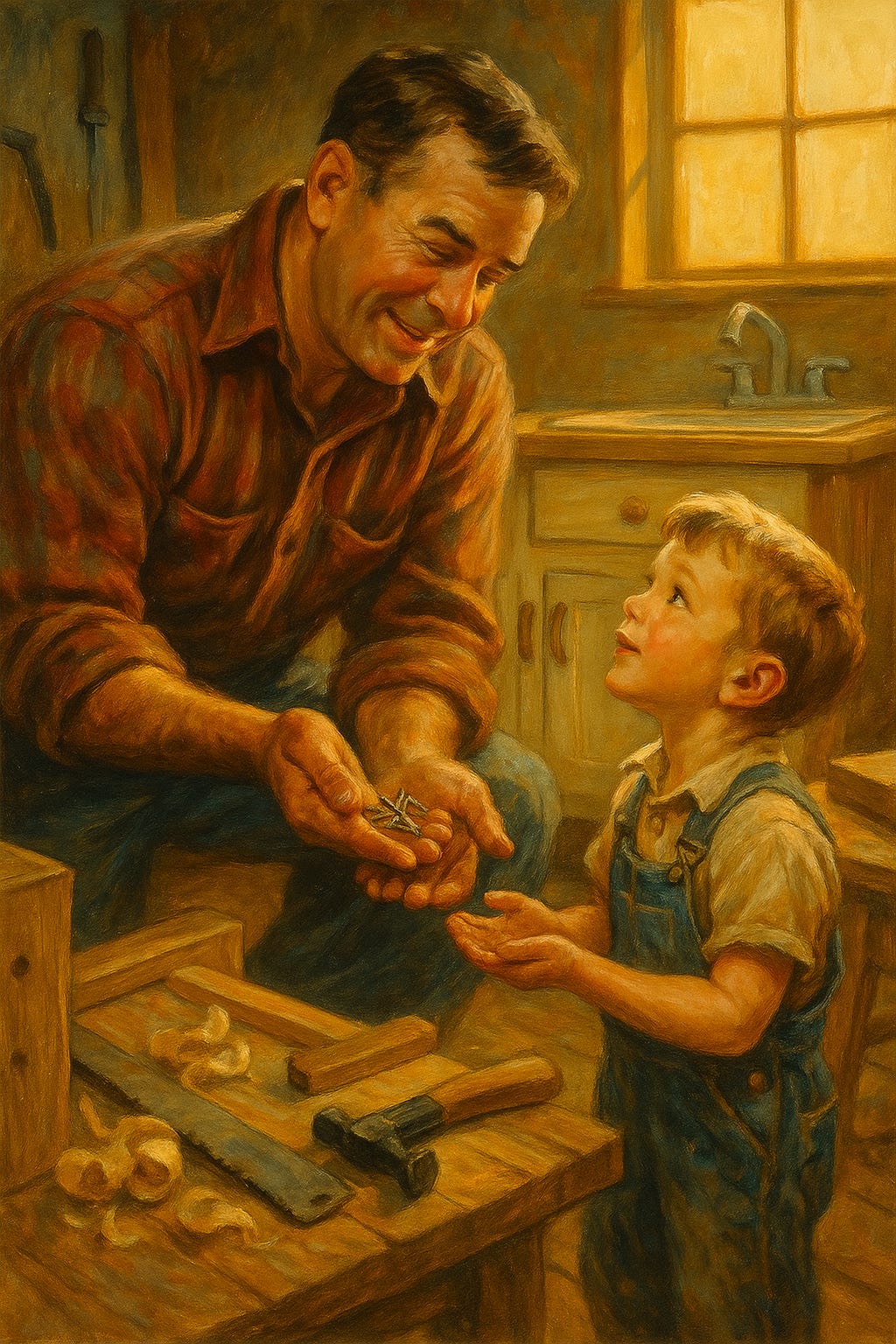
I remember the sawdust. I was five years old, and the garage was a cathedral of possibility. My dad and I were building a kitchen playset for my sister—my first real project. There were cabinets, a tiny table, even a sink with a bowl. My job was crucial: I was the keeper of the nails.
For days, I fetched them, one by one, from a rusty coffee can. I held boards steady with my small, earnest hands, and I swung a hammer with all the solemn seriousness a five-year-old can muster. In my mind, I was building this. My effort, my nails, my contribution was making it happen.
Then came my sister’s birthday. When she saw it, her face lit up with a joy I can still picture. And I beamed. Not just because she was happy, but because we had made this for her. My dad had done the hard parts—the measuring, the cutting, the structural heavy lifting—but he had let me participate in a way that was real and meaningful to me. The gift was from him, but it was also, in a way I felt deep in my bones, from me.
I’ve come to understand that this is a perfect picture of Christian ministry. Our Father is building His kingdom, and He invites us into the garage. He calls us to the work, and we, in our earnestness, clutch the nails—we preach a little, teach a little, pray a little, paint a little—convinced we’re carrying the project.
But the profound truth Scripture reveals is that He doesn’t need our hands.
The Apostle Paul stood in the midst of the intellectual center of Athens and declared this unshakeable fact about God: “He is not worshiped with men’s hands, as though He needed anything, since He gives to all life, breath, and all things” (Acts 17:25, NKJV).
The God who spoke galaxies into existence does not suffer from a manpower shortage. The One who holds the universe together by the word of His power does not need us to hold His plans together. He is utterly self-sufficient.
So why does He invite us in? Because He wants us. He is a good Father, and good fathers love to work alongside their children. He invites us to share in what He’s already building, so that the joy of the finished gift becomes ours, too. The work remains His, but the partnership is real.
The Biblical Blueprint for Co-Laboring
This isn’t just a nice idea; it’s a theological bedrock. Scripture has a specific term for it: we are co-laborers.
“For we are God’s fellow workers; you are God’s field, you are God’s building.” (1 Corinthians 3:9, NKJV)
Let that title sink in: God’s fellow workers. The Creator of all things calls us His colleagues. But the verse immediately defines the relationship. We are working His field; we are building His building. The ownership, the blueprint, and the ultimate outcome never leave His hands.
Paul elaborates just a few verses earlier, using the metaphor of planting: “I planted, Apollos watered, but God gave the increase. So then neither he who plants is anything, nor he who waters, but God who gives the increase.” (1 Corinthians 3:6-7, NKJV).
Our job is the faithful, obedient act: planting the seed, pouring the water. But we cannot command the seed to germinate. We cannot manufacture the growth. That is a miracle that belongs to God alone. We are the nail-holders; He is the master carpenter driving everything home.
Even our ability to do the work comes from Him. We are “His workmanship, created in Christ Jesus for good works, which God prepared beforehand that we should walk in them” (Ephesians 2:10, NKJV). The good works we do were prepared for us by Him. He lays out the nails, and then He gives us the privilege of holding them.
The Warning Against Swinging the Hammer Alone
And the moment we forget this—the moment we start to believe the project’s success rests entirely on our strength, our eloquence, our strategy—the weight of it will crush us. This is the fast track to ministry burnout, pride, or despair.
It is then we need to hear the whisper of the Spirit through the psalmist: “Unless the LORD builds the house, they labor in vain who build it.” (Psalm 127:1, NKJV).
We can strategize, organize, and mobilize, but if God is not in it, it is ultimately meaningless. Our frantic effort is just noise without His power. The beautiful truth is that He is building His house, His church. Our call is not to build it for Him, but to build it with Him, following His lead.
The Joy of Faithful Obedience
So what does this mean for us, Monday morning at the food bank, Tuesday night in the small group, Wednesday writing that Substack post?
It means we show up. We hold the nails. We do the small, faithful things with a heart full of trust. We let the Father shoulder the weight of the outcome.
He delights to work with His children, not because our strength is so impressive, but because His love is so profound. He is not a taskmaster looking for heroes; He is a Father raising sons and daughters.
And just like that birthday morning years ago, the joy you feel when you see a soul comforted, a truth understood, a life changed—that joy is itself a gift from your Father. It’s the joy of having participated in something eternal, something beautiful that He is doing.
The Takeaway: God’s recruitment poster doesn’t call for spiritual heroes; it welcomes beloved children. Our part is simple, obedient faithfulness. The results are His sovereign responsibility. As Jesus said, “Without Me you can do nothing” (John 15:5, NKJV). And as Paul urged, “We then, as workers together with Him, beseech you also not to receive the grace of God in vain” (2 Corinthians 6:1, NKJV).
So go ahead. Pick up your hammer. Clutch those nails with all the seriousness you can muster. Work with joy and diligence. But never forget who drew the plans, who provides the materials, and whose strong hands are guiding every swing.
He is building His kingdom. And in His glorious, gracious love, He lets us hold the nails.
— Robert Rousseau
Candlefish Ministries John 1:5
This was a most moving article, my brother, I love how you connected the love of a son with working on something big with his father. A great and most acceptable truth. I love the way the Lord uses your gift, my brother.
This is a powerful metaphor. You are so right that a good Father wants to work alongside his children. I am so grateful to be working with my sisters and brothers alongside our loving Father 🙏