

“Heavenly Things in the Night”
— An Exegesis and Teaching Article on John 3:10–21 (NKJV)

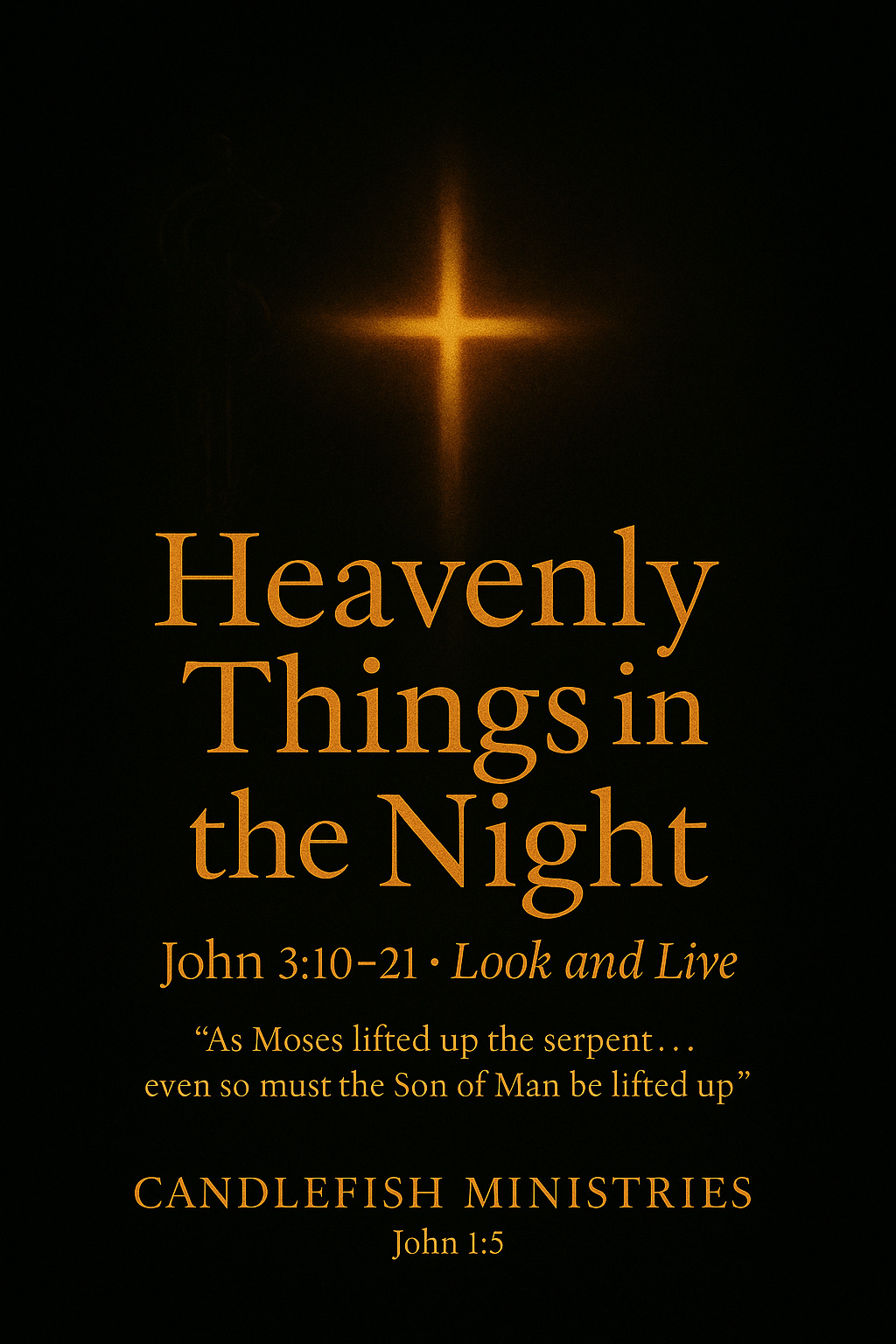
“Heavenly Things in the Night” — An Exegesis and Teaching Article on John 3:10–21 (NKJV)
Text: John 3:10–21 (NKJV)
Nicodemus arrives under cover of darkness, and Jesus brings the daylight to him. The passage is familiar—so familiar that we can race past its edges and miss its holy weight. John ties together rebuke and grace, judgment and mercy, the wilderness and the Cross, the classroom and the throne room. The result is a single, blazing proposition: life is found by looking to the Son who is lifted up, because the God who loves the world has acted to save it.
What follows is a careful walk through the text—line by line, image by image—paired with pastoral application for preaching, discipleship, and evangelism.
1) “Are you the teacher of Israel…?” (v. 10)
Jesus’ opening rebuke is surgical, not spiteful: “Are you the teacher of Israel, and do not know these things?” Nicodemus is more than a bright student; he’s a national-level instructor (the definite article, “the teacher,” suggests prominence). Yet he has missed truths that Israel’s Scriptures already signaled.
Which truths? The immediate context (vv. 3–8) concerned the new birth “from above”—new life by water and Spirit. Jesus’ wonder that a leading teacher didn’t know this points us back to promises like Ezekiel 36:25–27 (cleansing water and a new Spirit), Jeremiah 31:31–34 (a new covenant written on hearts), and even Genesis 2:7 (God’s breath animating dust). Israel’s Scriptures anticipated an inward, God-wrought renewal. Nicodemus knows the text, but not the transformation.
Pastorally, verse 10 humbles all of us—preachers, teachers, and ministry leaders. You can be an expert in religious vocabulary and remain a novice in spiritual reality. Jesus’ question calls for repentance from professionalized faith and a return to dependence on the Spirit.
2) “We speak what We know…you do not receive Our witness.” (v. 11)
Jesus shifts to testimony. The plural “We” likely gathers up Jesus’ works, the witness of the Spirit, John the Baptist’s testimony, and the Father’s own endorsement (cf. John 5). The problem isn’t data; it’s reception. “You do not receive Our witness.” Unbelief is not first an intellectual deficit but a moral and spiritual refusal of light (vv. 19–21).
This distinction steadies gospel ministry. We should give clear reasons for the hope within us, but we must never pretend that better arguments alone create new hearts. God uses words, yes—but the Spirit births belief.
3) “Earthly things” and “heavenly things” (v. 12)
“If I have told you earthly things and you do not believe, how will you believe if I tell you heavenly things?” “Earthly things” doesn’t mean trivial. It refers to earthly images—birth, water, wind—used to explain spiritual reality. If Nicodemus stumbles over those pictures, he will not grasp truths that require direct heavenly revelation.
Jesus is not downgrading the new birth; He’s exposing the limits of unregenerate understanding. Without faith, even the simplest metaphors of grace remain opaque. The order matters: regeneration opens the eyes; belief receives the truth; illumination follows submission to Christ.
4) The Son’s authority: descended, present, and destined to be “lifted up” (v. 13)
“No one has ascended to heaven but He who came down from heaven, that is, the Son of Man who is in heaven.” Two truths emerge:
Revelation’s direction: We don’t climb up to fetch truth; Truth descends. Wisdom is not discovered by religious mountaineering but revealed by the One from heaven.
The Son of Man’s identity: The title recalls Daniel 7:13–14—a heavenly figure who receives dominion and a kingdom. The NKJV phrase “who is in heaven” (a textual reading preserved in the tradition NKJV follows) underscores the Son’s unique relation to heaven even as He speaks on earth. Jesus claims preexistence, authority, and intimate access to the Father’s counsel.
The bottom line: Jesus alone is qualified to explain heavenly things—because He alone has come from there.
5) “As Moses lifted up the serpent…”—Cross-shaped typology (v. 14–15)
Jesus reaches into Israel’s wilderness story: Numbers 21:4–9. The people sinned; God sent fiery serpents; many died. God then commanded a bronze serpent to be lifted up: any who looked at it lived.
Jesus says: “Even so must the Son of Man be lifted up, that whoever believes in Him should not perish but have eternal life.” Three words to underline:
Must (dei): not accident, not plan B; divine necessity. The Cross is the ordained means of salvation.
Lifted up (hypsōthēnai): in John, the phrase holds a double meaning—crucifixion and exaltation (see 12:32–34). The lowest shame becomes the highest glory.
Whoever believes: In Numbers 21, looking was trusting God’s provision. In John 3, believing is looking to Christ crucified—reliance on the Father’s appointed remedy.
Notice what is not said: the serpent was not a charm; it was an act of obedient faith in response to God’s word. Likewise, faith in Christ is not religious technique. It is a helpless look that says, “You must save, and You alone.”
6) “For God so loved the world…”—love defined by action (v. 16)
This line is the gospel in a single sentence, but it is more than a slogan. Let’s read it slowly.
“For God so loved the world…” The adverb “so” (Greek houtōs) means “in this way.” John is pointing to the manner of divine love: God loved by giving. And the “world” (kosmos) in John often means humanity in rebellion—not a tidy audience predisposed to receive Him (cf. 1:10–11).
“…that He gave His only begotten Son…” Monogenēs in John highlights the Son’s unique, one-of-a-kind relationship with the Father—not a created son, but the only Son who shares the Father’s nature and glory (1:14, 18). Love does not send a messenger at arm’s length; love gives the Beloved.
“…that whoever believes in Him should not perish but have everlasting life.” This promise is both rescue (from perishing) and gift (everlasting life). In John, eternal life is not merely endless duration later; it is the life of the age to come experienced now—relationship with the Father and the Son (17:3). It begins in new birth and blossoms forever.
The verse answers two perennial lies:
“God is indifferent.” No—He loved in this way.
“The gospel is for other people but not me.” No—“whoever believes.” The nail-scarred door is open wide.
7) Mission and verdict: not to condemn, yet unbelief condemns already (vv. 17–18)
“For God did not send His Son into the world to condemn the world, but that the world through Him might be saved.” The mission is salvation. If we present Jesus primarily as a cosmic critic, we have inverted His purpose.
And yet verse 18 clarifies the verdict: “He who believes in Him is not condemned; but he who does not believe is condemned already.” The phrase “condemned already” signals a present, settled state. Unbelief is not neutral; it ratifies the world’s rebellion. To reject the Son is to reject the only antidote God has supplied. No other cure exists. The courtroom image stands: in Christ there is acquittal; outside Christ there remains the sentence.
This is why evangelism is not religious hobby but rescue work. People are not waiting for trial; they are already under judgment without the Son. The urgency is loving, not harsh.
8) Light and darkness: why some draw near and others retreat (vv. 19–21)
“And this is the condemnation, that the light has come into the world, and men loved darkness rather than light…” John has already told us “the light shines in the darkness” (1:5). Now he tells us why the light offends: “because their deeds were evil.” The rub is not light’s brightness but the sinner’s fondness for shadows. We do not merely do evil; apart from grace we love it.
Two phrases are worth pausing over:
“Everyone practicing evil hates the light” (v. 20). The word for “practicing” implies ongoing pattern and preference. Exposure threatens the arrangement, so the sinner avoids the light to protect the pattern.
“He who does the truth comes to the light” (v. 21). This is a striking Johannine phrase: doing the truth. Truth is not only affirmed; it is acted. Those whom grace has awakened come to the light—not because they think themselves spotless, but because they want their lives laid bare so that it becomes clear “that [their] deeds have been done in God.” The light reveals God as the true actor behind any good in us.
The pastoral takeaway is twofold. First, do not be surprised when the gospel provokes resistance—the light exposes. Second, shape ministry environments where coming to the light is safe because the Cross stands at the center. In a grace-shaped community, confession is not career-ending; it is life-beginning.
9) The theological thread—how the parts hang together
Revelation: Only the descended Son can explain heavenly things (v. 13).
Redemption: The Son must be lifted up; salvation is by believing look (vv. 14–15).
Reason: The Cross flows from the Father’s love (v. 16).
Result: Those who believe possess life now; those who refuse remain under judgment (vv. 17–18).
Response: Come to the light—live honestly before God so that it’s clear He is the author of any good in us (vv. 19–21).
This is not a string of pearls; it is a single jewel.
10) Teaching and Preaching Implications
A. For seekers like Nicodemus
Come with questions—but come to Jesus. He will not flatter our credentials, but He will give us Himself.
Let Scripture read you. If Nicodemus missed Ezekiel’s promise, perhaps we are also missing truth we can recite but haven’t received.
B. For church leaders and teachers
Beware expertise without experience. Jesus’ “Are you the teacher…?” is charitable but clear. We can be professionally religious and personally unrenewed. The cure is not shame but Spirit-wrought newness and a return to the Cross as our boast.
Preach the must. The Cross is not a footnote to Jesus’ moral teaching; it is the indispensable center (“must be lifted up”). Our pulpits should be serpent-on-a-pole places: look and live.
C. For evangelism and discipleship
Invite a look, not a ladder. People don’t need a spirituality workout plan; they need a sight of the saving Son.
Name the light. The gospel exposes patterns we prefer to hide. Create spaces where repentance is normal and restoration expected.
Hold the tension of 3:17–18. Jesus came to save; unbelief condemns already. This keeps our tone both tender and urgent.
11) Word Work: a few key terms (for teachers)
Monogenēs (“only begotten”): Emphasizes the Son’s uniqueness and belovedness, not creatureliness.
Hypsōthēnai (“lifted up”): Crucifixion and exaltation—a paradox of shame becoming glory.
Krisis (“condemnation”/“judgment”): In v. 19, “this is the judgment.” The point is not that God enjoys condemning, but that the arrival of light forces a verdict.
Doing the truth: A Johannine idiom for embodied integrity—not merely saying true things, but living openly before God.
Use these lightly. The aim isn’t to parade Greek but to clarify the gospel.
12) A teaching outline you can preach this week
Title: Look and Live: Heavenly Things in a Dark World
Text: John 3:10–21 (NKJV)
The Stunned Teacher (v. 10–12): Why knowing the Bible isn’t the same as new birth.
The Qualified Witness (v. 13): Only the Son from heaven can explain heavenly things.
The Necessary Cross (v. 14–15): The serpent lifted up; the Son lifted up; the look of faith.
The Love That Gives (v. 16): God’s saving initiative and the open door of “whoever.”
The Mission and the Verdict (v. 17–18): Saved through the Son; condemned already without Him.
The Light and Our Loves (v. 19–21): Why people hide—and why grace draws us into the light.
Big Idea: God’s love provides one saving sight: the lifted-up Son. Believe and live; come into the light and let God be seen as the doer of every good.
Gospel Call: “Look to Christ now. He has been lifted up for you.”
13) Discipleship prompts (for small groups or family tables)
Where do you resonate with Nicodemus—knowing the right words but needing new birth reality?
In what ways has the light exposed you recently, and how did you respond—hide or come forward?
How can our church become a ‘serpent-on-a-pole’ community—always directing people to look and live?
Who in your life believes they need a ladder to God? How can you invite them to look instead?
14) Candlefish application: living in the light
Our ministry carries a simple line under our name: “John 1:5.” “And the light shines in the darkness, and the darkness did not comprehend it.” John 3 shows what that looks like in human hearts. Some recoil; some come near. Our call is not to dim the light to make it less offensive, but to lift up the Son so clearly, so consistently, that every sinner knows exactly where to look.
That means:
We refuse the posture of religious gatekeepers. We are lamplighters who point to the Pole where Christ was lifted up.
We create confession-shaped communities where stepping into the light is met with gospel safety and practical help.
We keep “whoever believes” on our lips. The door is open to the rebel, the skeptic, the respectable, and the ruined—because the Cross is sufficient for all who come.
15) Closing exhortation
Nicodemus came by night. John 3 doesn’t tell us his final response here, but later we find him defending Jesus (John 7:50–52) and eventually anointing His body alongside Joseph of Arimathea (19:39–40). The man who once slipped through shadows steps into the light, carrying spices for a crucified King.
That can be you. That can be our churches. That can be the people we love.
Look to the lifted-up Son. Believe and live. Then come to the light—so that your deeds may be clearly seen to be done in God.
Thank you for providing surgical
clarity, line by line. It’s a good reminder that a PHD doesn’t necessarily mean you have GOD.