

In the Beginning: Why the Historical Adam Still Matters
“Through one man sin entered the world, and death through sin, and thus death spread to all men, because all sinned.” — Romans 5:12 (NKJV)

In the Beginning: Why the Historical Adam Still Matters
By Robert Rousseau | Candlefish Ministries
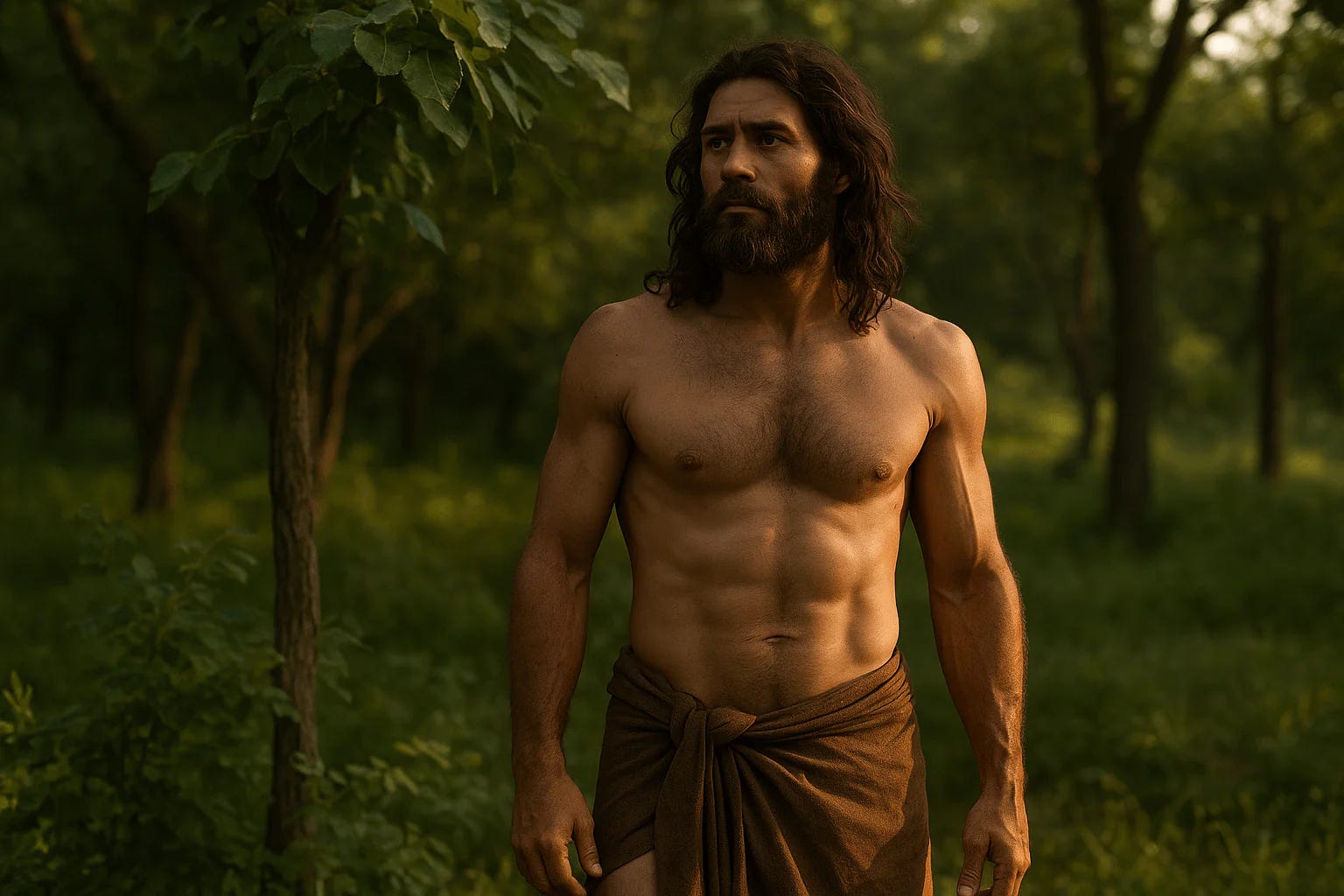
“Through one man sin entered the world, and death through sin, and thus death spread to all men, because all sinned.”
— Romans 5:12 (NKJV)
I once heard a theologian say, “If there was no Adam and Eve, then there was no Fall. And if there was no Fall, then there’s no need for a Savior.”
The room went quiet. He had cut through a century of scholarly debate with one sharp, theological plumb line.
The historicity of Adam and Eve isn’t a secondary issue for seminary debates. It is the foundation upon which the entire story of redemption is built. If Adam is a myth, then sin is a metaphor. If sin is a metaphor, then the cross is mere poetry—beautiful, perhaps, but powerless to save.
Our age, obsessed with evolutionary frameworks and mythological readings, has traded the flesh-and-blood first man for a symbol. But Scripture never offers us a symbol. The apostles never preached an allegory. And Jesus Himself never pointed back to a metaphor.
He pointed to a real man, a real woman, a real choice, and a real catastrophe that required His own very real death to undo.
The Bible’s Unbreakable Logic
The Genesis account is startlingly concrete. It doesn’t speak of a vague, primordial realm, but of specific rivers—the Pishon, Gihon, Tigris, and Euphrates (Genesis 2:10-14). It grounds humanity’s origin in the soil of real geography.
This historical realism is the only thing that makes the Apostle Paul’s theology make sense. In Romans 5:12-21, he draws a precise, parallel line between two men:
“For as by one man’s disobedience many were made sinners, so also by one Man’s obedience many will be made righteous.”
The logic is inescapable. The first Adam’s failure brings death. The last Adam’s (Christ’s) victory brings life. To dissolve the first Adam into myth is to unravel the second Adam into a sentimental story. The entire architecture of salvation depends on this historical correspondence.
What Science Actually Suggests
We’re often told science has disproven Adam and Eve. But a closer look reveals something more fascinating.
· Archaeology confirms that the region described in Genesis 2—the cradle of civilization in Mesopotamia—was indeed where early human societies, agriculture, and culture flourished. The biblical account is geographically grounded, not mythically vague.
· Genetics, far from erasing our origin, points to it. The discovery of “Mitochondrial Eve” and “Y-Chromosomal Adam”—scientific terms for our common maternal and paternal ancestors—affirms a profound truth: humanity shares a single origin. Recent studies even suggest a severe population bottleneck in our past, consistent with a small founding population.
· The Human Mystery remains. Anthropology has no naturalistic explanation for the “great leap” in human consciousness—the sudden appearance of art, ritual, and morality around 50,000 years ago. The Bible calls this the Imago Dei—the moment humanity was endowed with the image of its Creator.
Science, properly understood, doesn’t erase Genesis; it testifies to its profound coherence.
The Authority of Christ on the Line
This isn’t just a Pauline issue. It’s a Jesus issue.
When questioned on marriage, the Lord’s reply was definitive:
“Have you not read that He who made them at the beginning ‘made them male and female,’ and said, ‘For this reason a man shall leave his father and mother and be joined to his wife’?” (Matthew 19:4-5, NKJV)
Jesus bases His entire theology of marriage on the historical reality of Genesis 1 and 2. To deny the literal Adam and Eve is to stand in judgment over Christ’s own interpretation of Scripture. It ultimately questions His authority.

The Heart of the Matter: Why We Fight This Fight
The modern rejection of a historical Adam isn’t primarily driven by science; it’s driven by a philosophy—naturalism. This worldview sees the universe as a closed system and humanity as an accident of evolution. In this story, we aren’t fallen; we’re just unfinished. Sin isn’t rebellion; it’s a developmental glitch.
But this optimistic story cannot explain the deep, universal crack in human nature. Evolution might explain survival instinct, but it cannot explain guilt. It can describe tribal conflict, but not the human conscience that condemns it.
The Fall is the only story that makes sense of our glorious ruin. We are, as C.S. Lewis said, “bent mirrors.” We are capable of breathtaking love and unspeakable cruelty, of creating beauty and orchestrating horror. We bear the image of God, twisted by a self-will that we all recognize within us.
If you remove Adam, you remove the diagnosis. And without the diagnosis, the cure is meaningless.
The Gospel Begins in Genesis
The denial of Adam is never theologically neutral. It redefines sin as a social problem and salvation as self-improvement. But the Bible declares sin is transgression—a personal rebellion against a holy God that demands a penal substitution.
The gospel is not a therapy session; it is a rescue mission.
“For since by man came death, by Man also came the resurrection of the dead. For as in Adam all die, even so in Christ all shall be made alive.” (1 Corinthians 15:21-22, NKJV)
Every verb is historical. Came. Died. Made alive. The gospel is news, not legend. The last Adam conquers what the first Adam unleashed.
Adam and Eve remind us that our story began with real dust, real breath, a real choice, and a real catastrophe. And that is why our hope rests on a real cross, a real empty tomb, and a real returning King.
The Bible is unapologetically historical because God’s redemption unfolds in history. That’s not a myth. It’s a miracle.
And it’s the only hope that shines brightly enough to pierce the deepest darkness.
—
Robert Rousseau
Candlefish Ministries | John 1:5
Good stuff!
My favorite Quote: “The modern rejection of a historical Adam isn’t primarily driven by science; it’s driven by a philosophy—naturalism. This worldview sees the universe as a closed system and humanity as an accident of evolution. In this story, we aren’t fallen; we’re just unfinished. Sin isn’t rebellion; it’s a developmental glitch.”
The stuff that is taught in the institutes of “higher learning” today is simply “baal worship” all over again, dressed up to look pretty in modern guise.
Baal was “the god of natural forces”. In the same way today’s scientists have to “stimulate” nature to get the desired response, so too did the ancient baal worshipers “stimulate” their “god of forces” to achieve “control”. In other words, the problems today are just “developmental glitches” that “baal” can fix if we stimulate him enough.
There truly is nothing new under the sun. As Jonathan Cahn has written superbly in his book “the Return of the gods”, these “forces” always come back when they find “the house unoccupied……”
Interesting, insightful and full of scripture, my favorite type of reading!!!