

The Coming Therapeutic Inquisition
When Psychology Stops Healing and Starts Policing the Soul

The Coming Therapeutic Inquisition
When Psychology Stops Healing and Starts Policing the Soul
Let me say it up front:
The danger is not psychology as a tool—it’s psychology as a priesthood.
I’m not talking about every counselor, therapist, or psychiatrist. There are believers in those fields who genuinely care, who see people as image-bearers, and who quietly push back against the madness of our age.
What I’m talking about is something bigger and darker:
a secular priesthood
armed with diagnostic manuals instead of Bibles,
backed by courts, HR departments, and school boards,
claiming the right to declare what is healthy and harmful,
and increasingly willing to label biblical conviction as a disorder that must be treated—or punished.
In other words:
we are drifting toward a therapeutic Inquisition.
Not men in robes with racks and dungeons.
Men and women with licenses and credentials, backed by policy, law, and cultural power.
Let’s walk through this carefully.
1. What the Old Inquisition Actually Was
The medieval and early-modern Inquisitions (Catholic and Protestant varieties) had one core function:
Guard doctrinal “orthodoxy” by force.
They believed:
They were protecting the soul of Christendom.
Heresy was not just error; it was dangerous, contagious, and worthy of discipline—even death.
The church + state had both the right and the duty to enforce “truth.”
However sincere some individuals were, the net result was:
Coerced consciences
Punished dissent
Fear-driven compliance
People learned, very quickly, that there were some things you simply could not say—or even believe—without consequences.
Now fast-forward.
2. The New Creed: The Religion of the Self
Every Inquisition has a creed.
If the old creed was ecclesiastical (church dogma), the new creed is therapeutic:
The self is sovereign.
Authenticity is salvation.
“Harm” is the new heresy.
The chief end of man is to feel affirmed, validated, and free of guilt.
Romans 1 saw this coming:
“…they did not like to retain God in their knowledge…” (Rom. 1:28)
God is removed from the center. Man moves in.
But when you dethrone God, you don’t end up with freedom; you end up with new gods:
the State,
the Expert,
the Therapist.
And those gods need priests.
3. Psychologists as Priests of the New Order
Again, I’m not smearing every individual. I’m describing the role psychology increasingly plays in our culture.
Think about what priests did in old Christendom:
Named sin and virtue.
Mediated guilt and absolution.
Gatekept who was “in” and “out.”
Now look at the therapeutic establishment as it often functions today:
Naming “pathology” and “health.”
Holding biblical sexual ethics? That may be “harmful.”
Believing in objective truth claims? That might be “rigid,” “unsafe,” “extremist.”
Mediating guilt and relief.
If you feel bad, the answer is not conviction and repentance, but reframing:
“You didn’t sin; you were shamed.”
“Your problem is not rebellion; it’s low self-esteem.”
Gatekeeping “acceptable belief.”
In schools, workplaces, and courts, “experts” increasingly testify about what beliefs or statements create a “hostile environment.”
Laws are crafted around therapeutic categories like “harm,” “trauma,” and “safety”—often defined in ways that track neatly with the zeitgeist.
That doesn’t mean every therapist is malicious. Many are just playing by the rules they were trained in.
But from a 30,000-foot view, something is crystal clear:
The therapeutic class is becoming a kind of priesthood,
and their canon is not Scripture but the Diagnostic and Statistical Manual.
4. How a Therapeutic Inquisition Works
The old Inquisition asked:
“Is this teaching orthodox or heretical?”
The new one asks:
“Is this belief safe or harmful?”
The mechanics are eerily similar:
1. Redefine Sin as Sickness
Biblically:
Sin is moral rebellion against a holy God.
Guilt is real; conviction is mercy.
The answer is repentance and faith in Christ.
Therapeutic religion often says:
Sin is trauma, maladjustment, or conditioning.
Guilt is always “toxic shame.”
The answer is self-acceptance and affirmation.
Result:
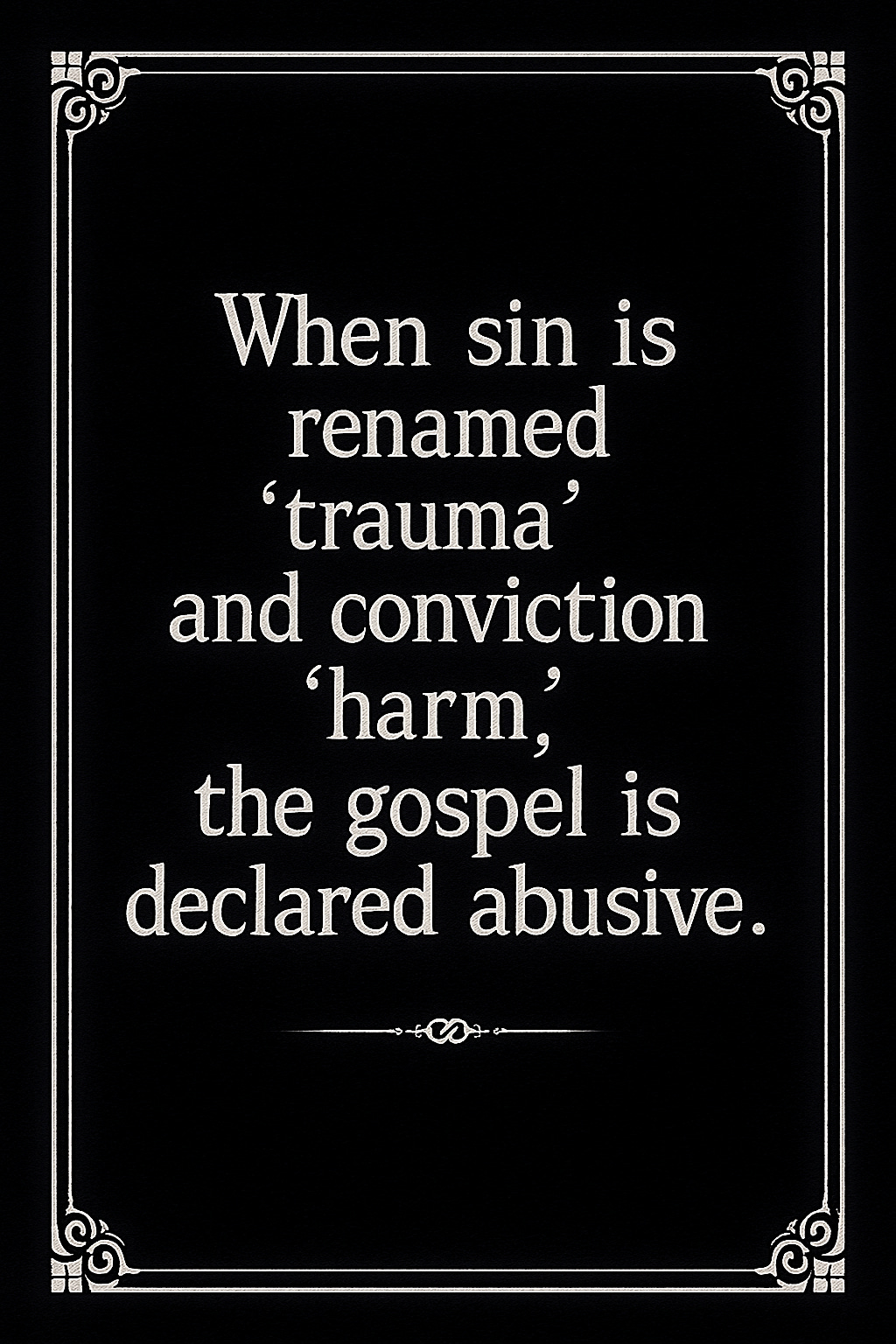
If you call people to repent, you’re the abuser.
Isaiah 5:20 warned us:
“Woe to those who call evil good, and good evil…”
The therapeutic inversion is:
Sin → “authenticity”
Repentance → “harm”
Conviction → “religious trauma”
2. Pathologize Biblical Conviction
A teenager feels conviction over sexual sin.
Bible: That’s the Spirit at work (John 16:8).
Therapeutic religion: “You’ve internalized harmful purity culture.”
A believer refuses to affirm gender ideology.
Bible: Obedience to created reality (Gen. 1:27).
Therapeutic religion: “You’re unsafe and bigoted—your beliefs are harmful.”
Suddenly, obedience is treated like a phobia and faithfulness like a mental defect.
3. Weaponize “Harm” and “Safety”
“Harm” used to mean actual damage.
Now it often means emotional discomfort at being contradicted.
When you combine this with law and policy:
Counselors forbidden to affirm biblical repentance in some areas.
Employees disciplined for “harmful” speech that is simply Scripture.
Parents framed as abusive for teaching what the Bible clearly says.
You don’t need dungeons when you have:
loss of livelihood,
loss of access,
loss of reputation,
loss of custody.
Different tools.
Same function: enforcing the creed, punishing the heretics.
5. What Scripture Actually Says About the Soul
The Bible does not deny that people have real mental and emotional struggles. It does, however, insist on a few non-negotiables:
We are body and soul.
We are not just chemicals; we are image-bearers. (Gen. 1:27)
Our deepest problem is sin, not misfiring neurons.
“The heart is deceitful above all things…” (Jer. 17:9)
“All have sinned and fall short of the glory of God.” (Rom. 3:23)
The primary healer of the soul is God, through His Word and Spirit.
“He restores my soul.” (Ps. 23:3)
“The law of the Lord is perfect, converting the soul.” (Ps. 19:7)
“For the word of God is living and powerful… and is a discerner of the thoughts and intents of the heart.” (Heb. 4:12)
Knowledge without love is deadly.
“Knowledge puffs up, but love edifies.” (1 Cor. 8:1)
Any “care” for the soul that denies sin, repentance, and the cross is offering anesthesia, not healing.
6. Where Psychology Can Help—and Where It Cannot
Here’s where we stay honest and balanced.
There is such a thing as:
trauma,
chemical imbalance,
neurological damage,
patterns of thought that need to be untangled.
Good, humble, common-grace psychology can:
help people recognize patterns,
give language to experiences,
offer tools for managing anxiety, processing grief, etc.
We don’t need to be Luddite fundamentalists who treat all therapy as demonic.
But we do need to be clear:
Psychology can describe; it cannot finally define.
It can suggest; it cannot stand as ultimate authority.
When psychology:
contradicts the clear teaching of Scripture,
denies moral responsibility,
re-labels sin as health and holiness as harm,
then it has wandered out of its lane and attempted to sit in Christ’s chair.
At that point, Christians must say:
“We must obey God rather than men.” (Acts 5:29)
Even when “men” have PhDs and diagnostic codes.
7. How the Remnant Should Respond
So what do we do?
1. Refuse to Bow to the New Priesthood
We honor real expertise. We’re grateful for genuine help. But we do not grant ultimate authority to any field that refuses to bow to Christ.
Colossians 2:8 warns:
“Beware lest anyone cheat you through philosophy and empty deceit, according to the tradition of men… and not according to Christ.”
That includes philosophies wrapped in clinical language.
2. Love the Broken, Not the System
Many who run to therapists are not rebellious; they’re bleeding.
Abuse survivors
Veterans
Kids from destroyed homes
People the church failed to shepherd
We don’t sneer at them for seeking help.
We don’t say, “Just read your Bible harder.”
We say:
Christ sees you.
His Word speaks to you.
If you seek professional help, weigh everything against His truth.
Don’t let anyone—pastor or psychologist—rewrite what God has said.
3. Expect Pressure
Jesus was blunt:
“If the world hates you, you know that it hated Me before it hated you.” (John 15:18)
As the therapeutic creed hardens, biblical conviction will sound more and more like “harm.”
You will be pressured to:
soften your language,
apologize for Scripture,
agree that certain verses are “traumatizing.”
Don’t.
We don’t have the right to edit God.
4. Build Real Pastoral Care
One reason the therapeutic priesthood has power is because the church often abandoned its own call to shepherd souls.
We replaced discipleship with content.
We replaced shepherds with event managers.
We left the deeply broken to fend for themselves.
If Candlefish and the remnant churches actually:
know their people,
bear burdens,
sit in hospital rooms, living rooms, and coffee shops,
weep with those who weep,
then the flock will be far less likely to hand their souls over to an ideology that cannot save.
8. The Line I’d Put on the Graphic
Your instinct line was:
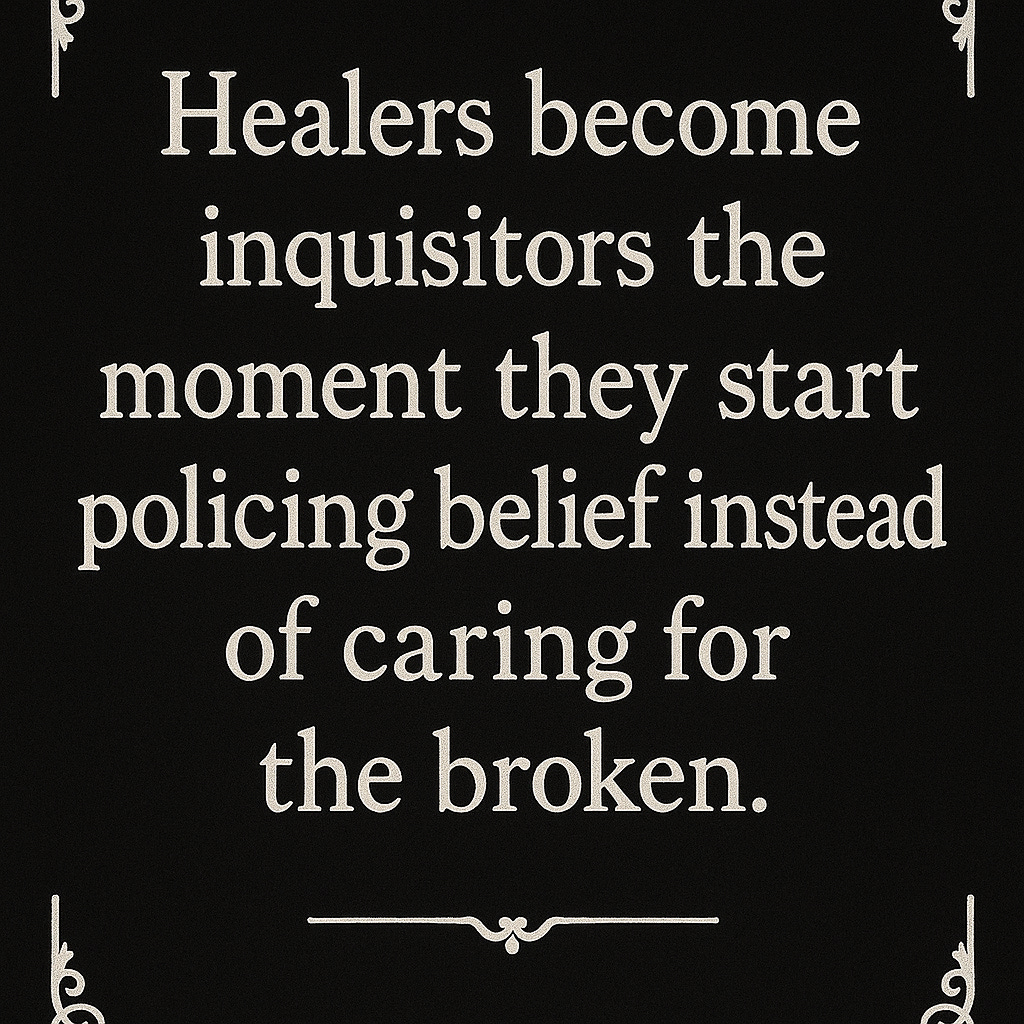
“Psychologists are the Priests of the next Inquisition.”
Here’s how I’d refine it for a Red Meat hammer:
In the next Inquisition, the priests won’t wear vestments;
they’ll wear lab coats and carry diagnostic manuals.
And in the caption:
Use psychology as a tool if needed,
but never as a priesthood.
There is one Mediator of the soul—
the Man Christ Jesus. (1 Tim. 2:5)
We’re not called to panic.
We’re called to discern.
The world will always have its priesthoods and inquisitions—religious, political, therapeutic. They come and go.
But there is only one true High Priest.
Only one who can truly heal the soul.
Only one whose verdict over you matters in the end.
And His name is not “Doctor.”
It is Jesus Christ, Lord of all.
Robert Rousseau
Excellent and thank you!
The truth is no therapist, no psychiatrist and no psych meds could ever heal me it was only Jesus whom stepped in and gave me by the gift of his grace through genuine holy spirit rebirth and made me a new authentic creation in him after I repented before him. And taught me what my true identity as Christ in me Jesus delivered me from demonic spirits and satan's entire kingdom of darkness and transferred me into the son of his love. Only Jesus, heavenly father and His holy spirit could ever reach such powerful deep woundings of repeated traumas and actual repeated psychosis, and break me free from my own bondage to sins too and radically heal and transform me and indeed save me. https://hephzibah78.substack.com/p/faithful-are-the-wounds-of-a-friend?r=3ltefe
https://hephzibah78.substack.com/p/portals-of-perception?r=3ltefe
As a Master Level Therapist I came to find out some disturbing things that I hoped I would never encounter.
First is that the whole of mental health for the most part has been usurped by medicine. My ability to perform as a therapist was guided by physicians.
Second, weekly utility reviews also emphasized how therapy was to be conducted. The idea of autonomy was fractured.
Addressing spiritual maladies was a huge no no.
We are witnessing exactly what this article is describing. The state is usurping mental health and healthcare in general.
Grateful to all those therapists that could buck the system, but I've found that most people's issues are spiritually based. They need Jesus Christ, not a better way to attach themselves to the world!