

When Christendom Drew Blood 🩸
Rome, the Reformers, and the Men Who Sat in Christ’s Chair

When Christendom Drew Blood 🩸
Rome, the Reformers, and the Men Who Sat in Christ’s Chair
We like our heroes clean.
We want Rome to be the obvious villain and the Reformers to ride in as spotless rescuers, cutting chains and handing out Bibles while choirs of angels hum “A Mighty Fortress.” We want an easy story: evil Church, good Reformers, and then—somehow—us, the enlightened heirs who got it all sorted.
History won’t let us have that fantasy.
Yes, Rome was brutal.
But the Reformers, many of them, kept the same sword and pointed it at different throats. And underneath both sat the same fundamental sin:
Men pretending to sit where only Christ belongs.
This isn’t about hating Catholics or despising the Reformation. It’s about refusing to worship any system that dares to take Christ’s place—Rome’s or Geneva’s or anyone else’s.
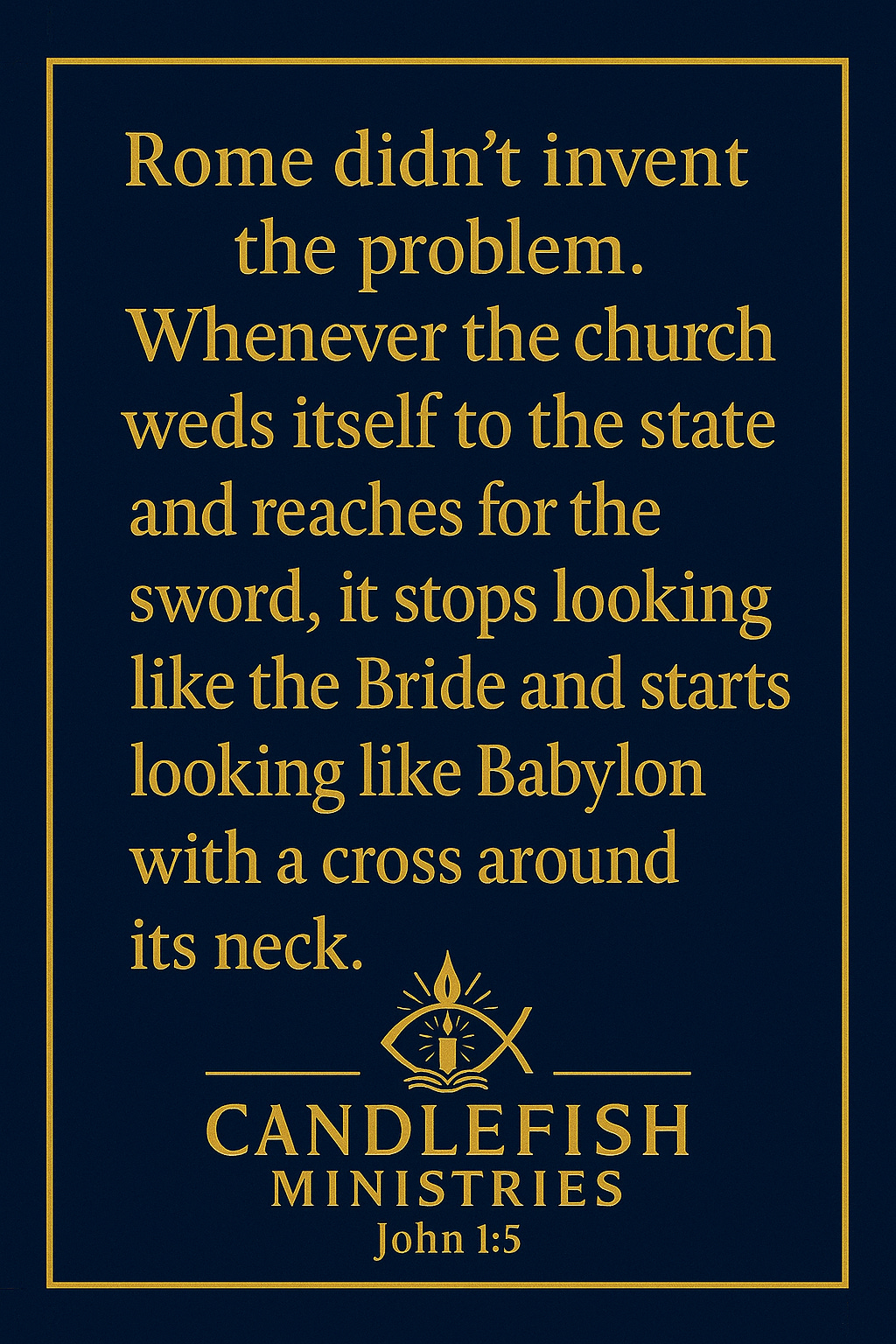
I write as a dispensational, pre-mil, pre-trib believer. I believe the Church is not the kingdom, the state is not the church, and no man or institution is the mediator between God and humanity. The more I read history, the clearer it is: whenever the Church reaches for the sword and the throne, it stops looking like the Bride and starts looking like Babylon with a cross around its neck.
Let’s walk through it.
Rome’s Long Shadow: When the Church Married the Sword
We don’t need to invent crimes against the Roman Catholic system. They’re in the record.
For centuries, Rome claimed to be the one true church, the exclusive steward of the sacraments, the visible kingdom of God on earth. With that claim came a terrifying conclusion: to oppose Rome was to oppose God.
What did that look like on the ground?
Inquisitions against “heretics,” enforced through:
prison,
confiscation of property,
torture,
and execution.
These weren’t fringe episodes; this was the machinery of a church that believed it had the right to break bodies to “save souls.”
Violence against Jews, in the name of Christ:
Forced ghettos and distinct clothing or badges.
Sermons and policies that treated Jews as “Christ-killers,” cursed wanderers, perpetual outsiders.
Periodic expulsions and sanctioned violence, justified with twisted theology and centuries of contempt.
Suppression of Bible believers who dared to question.
Groups like the Waldensians, who wanted Scripture in the language of the people and a simpler, apostolic faith, were hounded and persecuted.
The charge wasn’t “you hate Jesus.” It was: “you stepped outside mother church.”
All of this, done while claiming to represent Christ—the One who told Peter to put away his sword and who laid His own life down for His enemies.
If that were the whole story, we could wrap this up as a simple Catholic vs. Protestant morality tale.
But it’s not.
The Reformers: New Theology, Same Sword
God used the Reformation. He really did.
The recovery (or clearer articulation) of justification by faith, the insistence on Scripture’s authority over councils and popes, the exposure of indulgence-selling and blatant corruption—these were needed. Rome had choked the gospel with tradition, power, and fear.
But here’s the piece we have to face honestly:
Many of the magisterial Reformers—Luther, Calvin, Zwingli, and their state-church heirs—copied Rome’s structure while changing the paperwork.
They condemned Rome’s false doctrine, then used Rome’s methods against their own dissenters.
Geneva: Calvin’s “Reformed” Christendom
Take Geneva under John Calvin.
Calvin was brilliant, zealous, serious about the holiness of God. He wrote profound things about the sovereignty of God and the majesty of Christ.
But in Geneva, church and state fused, and the result looked far less like the Book of Acts and far more like a sanitized Inquisition.
The Consistory (the church court) and the civil authorities worked in tandem.
Moral crimes and doctrinal deviations became civil offenses.
People could be:interrogated,
fined,
exiled,
or worse—for “wrong” beliefs or behaviors.
The most famous case: Michael Servetus.
Servetus was a heretic—he denied the Trinity, rejected orthodox Christology. He was wrong, dangerously wrong.
But what did Geneva do?
They burned him alive.
Yes, there was a trial. Yes, other cities wanted his blood too. Yes, it was “normal” for the time.
None of that changes the fact:
A city shaped by a Reformer’s theology answered false doctrine with fire instead of with preaching, discipline, and excommunication.
Calvin didn’t personally light the torch. But he approved the process and endorsed the sentence. That’s not “Christ alone.” That’s Christ plus the sword of the state, wielded by men who believed they held the keys.
Zurich and Zwingli: Drowning the Anabaptists
Look at Ulrich Zwingli and the Swiss Reformation in Zurich.
The Anabaptists weren’t perfect. They rejected infant baptism, rejected the church–state fusion, and insisted that only genuine believers should be baptized and gathered into the church. They wanted a New Testament church in the shadow of a state-church system.
Zurich’s answer?
They drowned some of them.
It was a cruel joke in the name of Christ:
“So you like baptism? Here’s a third one.”
We’re not talking about thugs in an alley. We’re talking about a Reformed city government, in cooperation with ecclesiastical leadership, using the river as a gallows.
Again, new theology. Same sword.
Luther: From Gospel Clarity to Poisoned Pen
Martin Luther thundered against Rome’s corruption and recovered the clarity of salvation by grace through faith. Praise God for that.
But Luther’s record is not spotless:
In the Peasants’ War, when abused peasants rose up (often in terrible ways), Luther wrote harshly urging the princes to crush the revolt mercilessly. That’s not all on him—but the tone and rhetoric are there.
Most disturbingly, his later work “On the Jews and Their Lies” is filled with savage, hateful language toward the Jews:
calling for burning synagogues,
destroying Jewish homes,
and expelling them.
He wasn’t alone in this hostility, but someone who preached Christ crucified also wrote words that centuries later would be echoed in the darkest chapters of Europe.
Again: new doctrine in some areas, old contempt in others.
State Churches: Protestant Christendom
Broadly across Europe:
Lutheran, Reformed, and Anglican state churches often:
enforced uniformity,
punished dissenters,
and crushed radicals and separatists.
Baptists, Anabaptists, and other free church movements were:
fined,
imprisoned,
banished,
sometimes killed.
Rome had her Inquisition.
Protestant states had their own version—legal, respectable, but with the same bone structure:
“Believe as we say, worship as we prescribe, or face the consequences.”
This is not “the priesthood of all believers.”
This is Christendom with new confessions, still running on fear, coercion, and the sword.
How Their Violence Helped Push Believers Toward the New World
When Rome and the Reformers both make it dangerous to follow conscience—who is safe?
Many of those who eventually fled to the New World weren’t rejecting Christ. They were rejecting the relentless pressure of Christendom—Catholic and Protestant.
They wanted to worship according to Scripture, without a pope or a prince standing over their shoulder.
They had tasted persecution from both sides:
Rome called them heretics.
Protestant states called them radicals.
So they ran.
Did the New World live up to the ideals? Not perfectly. Some of the same persecuting instincts came across the ocean.
But the impulse was right:
“Get out from under the men who sit in Christ’s chair,
and give the Bible back to the people of God.”
The Common Sin: Men Between Christ and His People
Rome has its horrors.
The Reformers have their horrors.
The common denominator is not the name on the church door. It’s this:
Men claiming a level of authority that belongs only to Christ and His Word.
You see it when:
A church claims to be the exclusive mediator of grace.
A confession or system becomes untouchable, and Scripture must be bent to fit it.
The state is used to enforce doctrine at the point of a sword or the threat of prison.
Whole peoples—like the Jews—are written off as less than human, beyond God’s mercy, “Christ killers,” outside His plan.
Whether it’s a pope in Rome, a council in Trent, a consistory in Geneva, or a synod elsewhere, the pattern is the same:
Claim to stand uniquely in Christ’s place.
Claim authority to define the faith for all.
Use coercion—social, legal, or physical—against those who disagree.
That’s not the New Testament church.
That’s Rome’s spirit, even when it wears a Reformed cloak.
Dispensational Glasses: Why This Matters Theologically
From a dispensational, pre-mil, pre-trib perspective, all of this is exactly what we’d expect from a Christendom that’s confused the Church and the Kingdom.
The Church is a called-out body, born at Pentecost, made up of Jew and Gentile, saved by grace through faith in Christ.
The Kingdom in fullness is future—Christ’s literal rule on earth.
No state-church fusion, no earthly institution, no “Christian nation” can bring that kingdom in or speak as if it already fully rules through them.
Whenever the Church tries to act as the kingdom, it grabs:
political power,
coercive authority,
and territorial control.
And it inevitably draws blood “in Jesus’ name.”
Rome did it.
The Reformers did it.
Their successors still do it in softer, more respectable ways.
But the New Testament is clear:
“For the weapons of our warfare are not carnal but mighty in God for pulling down strongholds.” (2 Corinthians 10:4, NKJV)
“My kingdom is not of this world. If My kingdom were of this world, My servants would fight…” (John 18:36, NKJV)
If your “church” needs the state’s sword, prison, or economic punishment to sustain itself, it’s not following the Lamb who was slain. It’s following a different spirit.
Rome’s Pretenders Today
Rome still claims too much. That hasn’t changed.
But “Rome’s pretenders” aren’t limited to the Vatican.
You see the same pattern when:
Reformed gatekeepers talk as if their confessions are the only faithful reading of Scripture and all dissent is suspect.
Teachers sneer at Israel, calling Jews “Christ-killers,” “no longer God’s people,” or worse—dehumanizing them while quoting Paul, who wrote that they are still “beloved for the sake of the fathers” and that God’s gifts and calling are irrevocable (Romans 11:28–29).
Publishers quietly revise Bible translations over and over, smoothing out offense and bending language to modern tastes while insisting the label hasn’t changed.
It’s the same disease:
“Trust us.
We will stand between you and Christ.
We will tell you what the Bible really says.
Stand under our umbrella, or stand outside of God’s favor.”
That’s why your faith cannot rest in Rome or Reformers or denominations or celebrity pastors or translation brands.
They will move. They will fail. Some will draw blood.
Christ will not.
Not Men—Christ Alone
This is not about swapping one hero for another.
Rome is not the answer.
The Reformers are not the answer.
Your favorite “tribe” is not the answer.
Christ alone is.
He:
Saves, without sacraments or systems as co-mediators.
Speaks in His Word, which no council or confession has the right to edit.
Keeps His people by His Spirit, not by the fear of prison or loss of status.
Fulfills His promises—to Israel, to the Church, to all who trust in Him—without asking permission from popes or Protestant princes.
So yes—Rome has shed blood.
So have the Reformers.
They were no better when they reached for the same sword.
The call to you is simple and hard:
Don’t put any man, system, or tradition in the seat that belongs to Christ alone.
Don’t bow to Rome’s pope—or Geneva’s.
Don’t let “Christendom” replace Christ.
If you’ve been wounded by Rome, by Reformed theobros, by harsh gatekeepers, by institutions that used Jesus’ name as a weapon:
You are not crazy.
You are not alone.
And you are not called to spend your life fighting for or against those thrones.
You are called to come to Christ Himself.
Not men.
Not Rome.
Not Reformers.
Christ alone.
Robert I love this piece.
There are many who deny God, especially Jesus, because they can’t wrap their logical minds around the idea of him. But I think an even larger number deny him, and with greater indignation, because of the humans representing him.
They have witnessed not only Rome and reformers, but so called believers in their everyday lives who demand faith and belief through psychological force and coercion. Many who preach the loudest preach through the tainted filter of their ego. Some have sincere intentions with a faulty approach. Others deceive with the spirit of Lucifer wearing the mask of Christ.
Mankind needs to get out of the way and allow Christ to speak for himself.
This is the best post I have ever seen on this subject. And I mean in my life that I've ever seen. I thank you very much for this. And I'm going to send you a DM about something else that connects to this. Bless you Robert.