

When the Curtain Tore

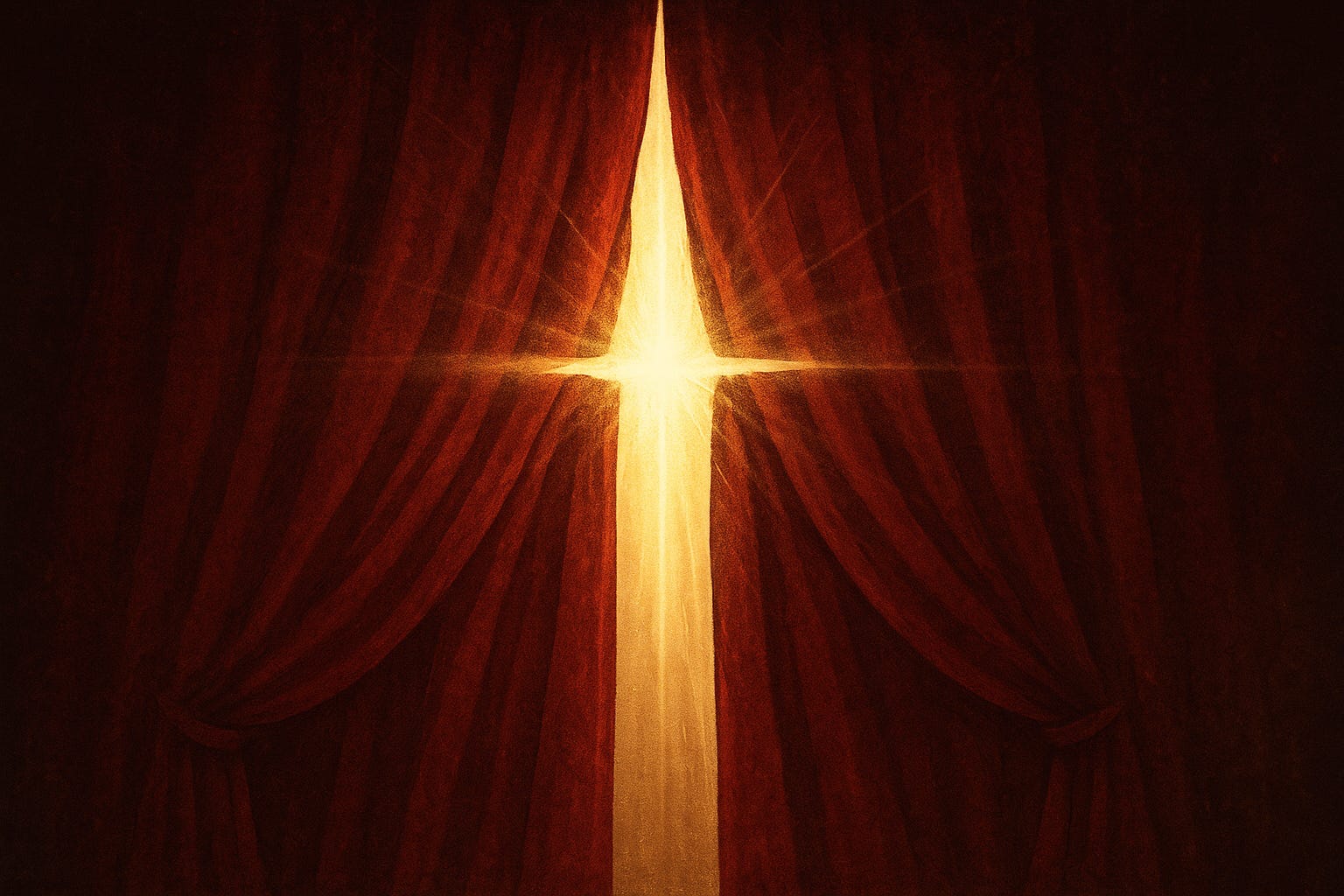
When the Curtain Tore
By Robert Rousseau
Candlefish Ministries
“The light shines in the darkness, and the darkness did not comprehend it.” — John 1:5 (NKJV)
It happened in a single breath.
At the very moment Jesus cried out, “It is finished,” and gave up His spirit, something unthinkable took place miles away in Jerusalem:
“Then, behold, the veil of the temple was torn in two from top to bottom” (Matthew 27:51, NKJV).
It wasn’t a whisper or a ripple. It was a divine rupture — heaven tearing open what man could never touch.
A Barrier No Man Could Cross
The temple veil wasn’t a thin curtain fluttering in a breeze. Jewish tradition tells us it was as thick as a man’s hand, woven of fine linen and blue, purple, and scarlet threads — a visible reminder that God’s holiness was not to be trifled with. Behind it stood the Most Holy Place, where the high priest entered only once a year, trembling, with the blood of atonement (Leviticus 16).
That curtain wasn’t decorative. It was defensive.
It said: “You may come this far — and no farther.”
The veil represented the unbridgeable divide between a holy God and sinful humanity. It was the ultimate “keep out” sign, the physical symbol of what sin had done since Eden: separate man from the presence of God.
And then, suddenly, it was gone.
From Top to Bottom
The detail matters: it tore from top to bottom.
This wasn’t human vandalism. No priest climbed a ladder to shred it in protest.
God Himself reached down and ripped the barrier apart.
That motion — top to bottom — tells the whole gospel story.
Religion always tears from the bottom up. It tries to work its way toward God, stitch by stitch, sacrifice by sacrifice, effort upon effort.
But grace tears from the top down.
When Christ died, God wasn’t simply making a statement — He was making a way.
As the writer of Hebrews later put it,
“We have confidence to enter the Most Holy Place by the blood of Jesus, by a new and living way which He consecrated for us, through the veil, that is, His flesh” (Hebrews 10:19–20, NKJV).
The torn curtain wasn’t just a sign of access; it was a sign of intimacy. Through Christ’s own body — torn for us — God invited us into His presence, not once a year, but forever.
Access, Not Distance
For centuries, only one man could step behind that veil — and only with blood, trembling, and incense. Now, through Jesus, every believer is welcomed in.
The temple said “keep out.”
The cross says “come in.”
And yet, many of us still live as if the curtain were still hanging. We pray timidly, worship cautiously, and carry guilt like contraband in a holy place. We forget that the price has been paid, that access is granted, that the dividing wall has already fallen.
The curtain wasn’t mended after it tore. The priests, stunned and frightened, couldn’t fix what God had finished.
And you can’t either.
You can’t rehang what God has removed.
The veil is gone.
The way is open.
Earthquakes and Awakenings
Matthew notes something else in that same verse:
“The earth quaked, and the rocks were split” (Matthew 27:51, NKJV).
Creation itself convulsed at the death of its Maker. The ground shook because heaven moved.
It was as if the world realized what had just happened — that the blood of the Lamb had done what no system, no sacrifice, no striving ever could.
And in that trembling, a new world began.
From that moment forward, access to God was not through ritual, but relationship. Not through temple, but through trust.
The early believers understood this. They didn’t need an altar, because the altar was now a cross. They didn’t need priests, because the High Priest had entered once for all. They didn’t need to fear the Holy of Holies, because the Holy One had come out to them.
The Torn Curtain and the Open Heart
Every time we come before God in prayer, every time we whisper “Father,” we’re walking through that torn curtain.
We don’t enter trembling, but trusting.
We don’t stand outside, but inside.
Christ did not die to bring us into religion — He died to bring us into relationship.
The temple veil tore so that your heart could open.
If that truth doesn’t move us to worship, nothing will.
Application: Living Beyond the Veil
• Pray boldly. You’re not interrupting a busy God; you’re responding to an open invitation (Hebrews 4:16).
• Worship freely. The curtain is gone — there’s no sacred distance left to fear (John 4:23–24).
• Walk confidently. You belong in the presence of God, not as a guest, but as His child (Romans 8:15–16).
The curtain tore once, but the invitation stands forever.
The hand that ripped the veil now reaches for ours.
The voice that cried “It is finished” still whispers, “Come to Me.”
And when you do, you’ll find that the holy place you once feared has become the home your heart was made for.
Robert Rousseau
Candlefish Ministries
John 1:5
Well Robert you've done it again! Well I guess I should say God has done it again. It never fails. I had a question in my mind today about the Veil that was torn. I mean I understand all of it about the Veil but I just had some questions. And then I come across your post here. It's 12:00 about 4 minutes after and the Lord has shown me what it was but I was questioning. That is how our amazing God works. He always answers and all we have to do is wait a little while. Thank you very much Robert.
Back when I was an alcoholic it seemed nothing would break through. No thing, no one, no how. And I remember the middle of the night in one of my rare lucid moments, I read about the curtain tearing from *top to bottom*. At that moment, God reached down, opened my addiction from His side, and I haven't had a drink since. I never lost hope after seemingly everything had failed. But He didn't. 🙌🏻✝️✨️