

Works Without Faith Are Vanity
By Robert Rousseau – Candlefish Ministries John 1:5

Works Without Faith Are Vanity
By Robert Rousseau – Candlefish Ministries John 1:5
Some burdens are invisible.
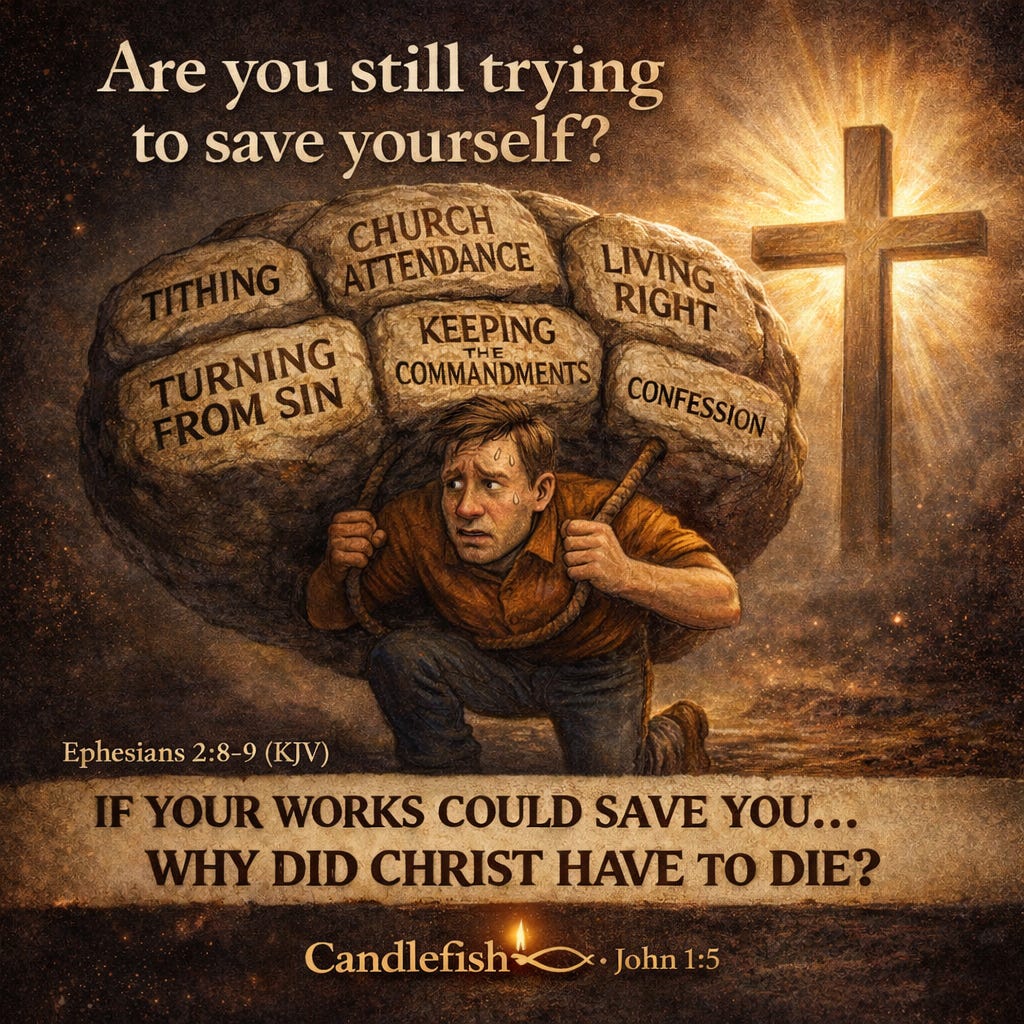
You can be a church kid, a Bible reader, a “good person,” and still feel like that man in the picture—crushed under a boulder of expectations you can never quite carry. Tithing. Serving. Confessing. Turning from sin. Living right. Keeping the commandments. You know the list.
You might even agree that salvation is “by grace through faith,” but deep down you still live as if Jesus got you started and the rest is up to you.
That’s why the line on this graphic hits so hard:
“Works without faith are vanity.”
Not just exhausting. Not just frustrating. Vanity—empty, hollow, meaningless.
Let’s talk about why.
The Law Shows Our Need, Not Our Strength
Paul says:
“Therefore by the deeds of the law no flesh will be justified in His sight, for by the law is the knowledge of sin.”
— Romans 3:20 (NKJV)
The law is like an X-ray: it reveals the break; it doesn’t heal it.
God’s commands are holy, just, and good (Romans 7:12). They show us what righteousness looks like. They expose the truth we work so hard to avoid—that we are not righteous in ourselves.
The more seriously you take God’s law, the more clearly you see the problem:
Love the Lord your God with all your heart, soul, mind, and strength.
Love your neighbor as yourself.
Be holy, for I am holy.
Who can carry that? For a day? For a lifetime? The honest answer is simple: none of us.
So when we grab our spiritual shovel and try to dig ourselves out with “more effort,” the law only digs the hole deeper. It keeps shouting:
“You’re not enough. You never were. You never will be.”
That’s not cruelty—that’s clarity. The law is doing its job.
Grace Isn’t Plan B
Into that heaviness, Paul drops this:
“For by grace you have been saved through faith, and that not of yourselves; it is the gift of God, not of works, lest anyone should boast.”
— Ephesians 2:8–9
Grace isn’t God lowering the bar. It’s God meeting the bar Himself in Christ, then giving that righteousness to us as a gift.
Jesus didn’t come to give us better ladder-rungs to climb up to God. He came because we were dead in trespasses and sins (Ephesians 2:1). Dead people don’t climb; they need resurrection.
At the Cross, Jesus took the full weight of the law’s verdict against us:
Every broken commandment
Every selfish motive
Every secret sin we’ve tried to manage instead of confess
He carried it, paid it, and cried out, “It is finished!” (John 19:30).
If our works could save us—or even help—then the Cross was divine overkill. Paul doesn’t leave room for that:
“I do not set aside the grace of God; for if righteousness comes through the law, then Christ died in vain.”
— Galatians 2:21
That’s the heart of the graphic: if works can save you, the death of Christ is unnecessary.
But if the death of Christ is sufficient, then trusting your works is not just exhausting—it’s vanity.
But What About James? “Faith Without Works Is Dead”
Someone always asks, “What about James 2? Doesn’t the Bible say ‘faith without works is dead’?”
Yes—and it’s exactly right.
James is not saying we are saved by works. He’s saying that genuine faith cannot stay fruitless.
If you claim to have faith but there is absolutely no evidence of new life, no hunger for God, no conviction over sin, no growth over time—then what you’re calling “faith” may be nothing more than religious fog.
Think of it this way:
Paul is answering the question: How is a guilty sinner declared righteous before God?
Answer: By grace alone through faith alone in Christ alone (Romans 3–5).
James is answering: What does real, saving faith look like in everyday life?
Answer: It produces visible fruit—acts of love, obedience, and sacrifice (James 2:14–26).
Two sides of the same coin.
We are saved by faith alone, but the faith that truly saves is never alone.
When Works Become a Burden Instead of Fruit
Here’s a simple way to test your own heart:
Does serving God feel like paying off a debt you secretly know you’ll never finish?
Do you live in fear that one bad week, one relapse, one failure will drop you out of God’s favor?
Do you see God more as a disappointed boss than a loving Father?
If so, your works have quietly slipped into the Savior’s seat.
You may still use the word “grace,” but functionally you’re hoping your performance will keep God from regretting His decision to save you.
That’s vanity.
Not because obedience doesn’t matter—but because obedience was never meant to be your lifeline. Jesus is.
Works as Worship, Not Currency
Look at what Paul says immediately after Ephesians 2:8–9:
“For we are His workmanship, created in Christ Jesus for good works, which God prepared beforehand that we should walk in them.”
— Ephesians 2:10
We are not saved by good works, but we are absolutely saved for good works.
Once you are in Christ:
You don’t pray to earn love; you pray because you are loved.
You don’t give to buy favor; you give because you already have favor in Christ.
You don’t serve to secure your place; you serve because your place is secure.
Works become worship, not currency.
Think about that man under the boulder in the graphic. When Christ lifts the weight of “save yourself,” the same man might still be tithing, still attending church, still fighting sin—but now it’s with a different heart:
Not “Maybe this will be enough,” but “Thank You, Jesus, that You already were enough.”
Where This Gets Real
Some of us grew up in churches where the gospel was basically:
“Jesus did His part—now you do yours.”
Or:
“Yes, you’re saved by faith, but…”
That “but” has chained more believers than some open sins ever have.
If that’s you, hear this:
You will never out-sin the power of Christ’s blood.
You will never out-perform the perfection of Christ’s righteousness.
You will never surprise God with a weakness He didn’t already know when He saved you.
The Cross is not God’s down payment waiting for your installments.
It is paid in full.
Your part is to repent and believe—to throw yourself entirely on Jesus, no backup plan, no spiritual résumé in your back pocket “just in case.”
From there, yes, walk in obedience. Grow. Serve. Sacrifice. Let the Spirit produce fruit in you. But do it as a child, not as an employee; as someone secure, not someone bargaining.
Final Word: Drop the Boulder
So let me ask you the same question the graphic asks:
Are you still trying to save yourself?
Have you quietly hitched your hope to your own goodness, your consistency, your ability to “hold on”?
If so, hear the invitation of Jesus:
“Come to Me, all you who labor and are heavy laden, and I will give you rest.”
— Matthew 11:28
Not a softer yoke of law.
Not a lighter boulder of self-effort.
Rest. In Him.
Works without faith really are vanity.
But faith in the crucified and risen Christ—that is never empty.
Drop the boulder.
Cling to the Cross.
Then let every good work that follows be the grateful echo of a heart that knows:
“It is finished.”
Amen to that! Rather than follow a list of rules, God wants us to obey and do good works out of love for Him...
Amen.