

When Devotion Becomes Displacement
The Marian System of Rome Beside the Written Word of God

When Devotion Becomes Displacement
The Marian System of Rome Beside the Written Word of God
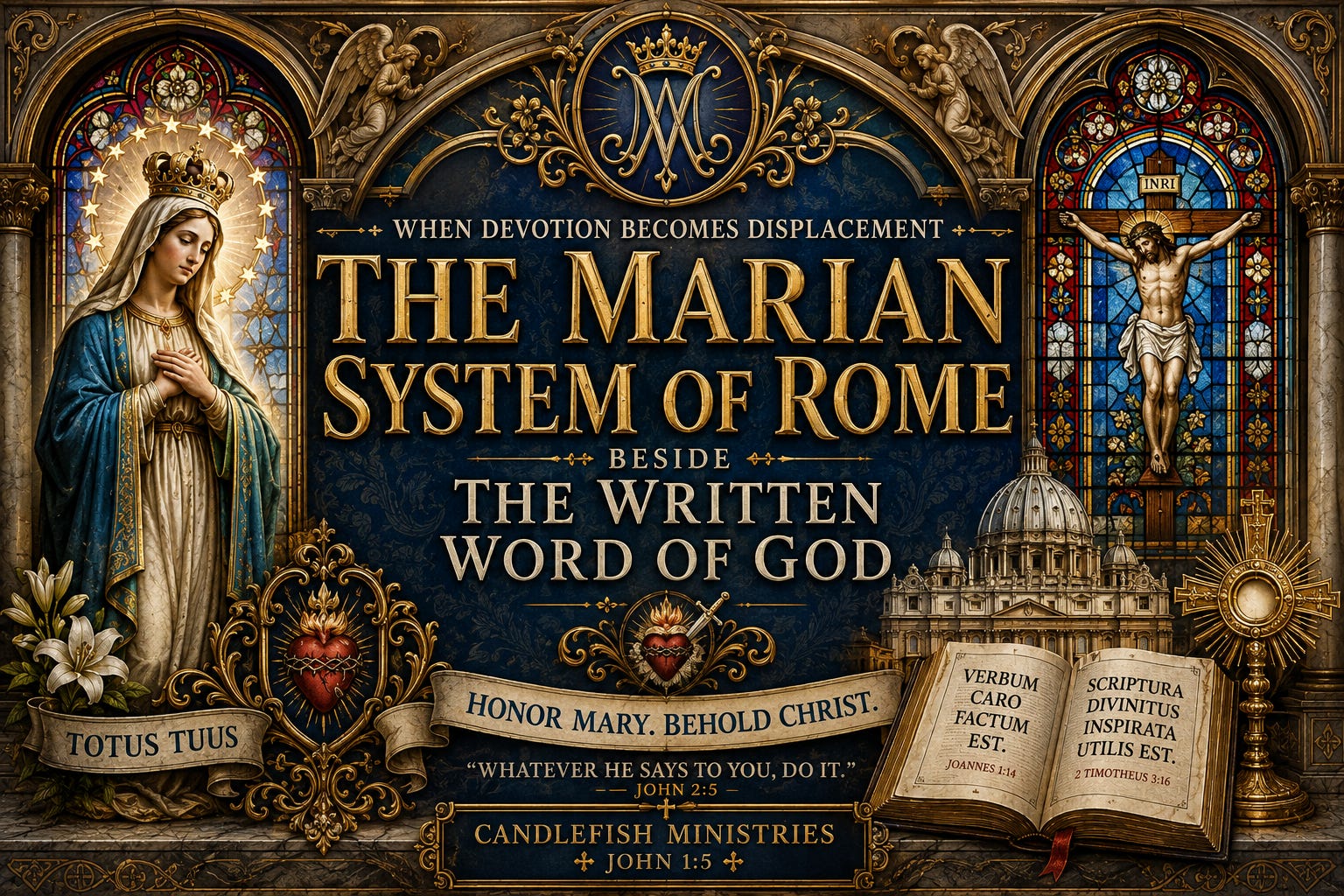
By Robert Rousseau
Candlefish Ministries John 1:5
Mary deserves honor.
She was chosen by God for an extraordinary privilege. She carried the incarnate Son of God in her womb. She believed the word spoken to her. She called herself the Lord’s maidservant. She endured misunderstanding, sorrow, and the agony of watching her Son crucified.
Scripture calls her blessed among women.
Christians should never speak of Mary with contempt.
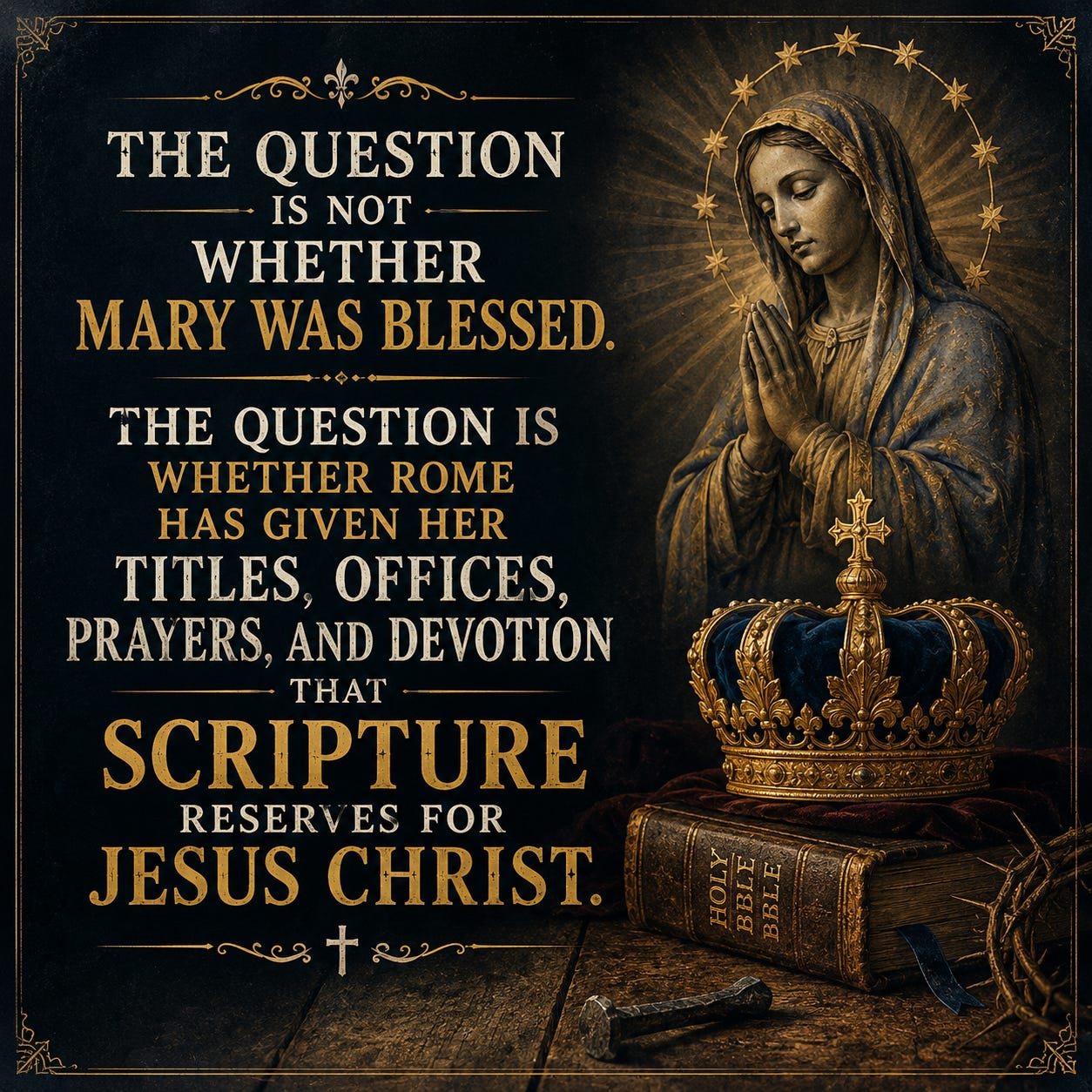
But neither should we give Mary titles, offices, prayers, confidence, or devotion that the apostles never gave her and that Scripture reserves for Jesus Christ.
That is the issue.
The question is not whether Mary was blessed.
The question is whether Roman Catholic devotion has moved far beyond the Mary of Scripture and constructed a Marian system that places her between the believer and Christ.
Rome insists that it does not worship Mary. Catholic theology formally distinguishes the adoration owed to God from the special veneration offered to Mary. The Catechism describes Marian devotion as distinct from the adoration given to the Trinity.
That distinction should be acknowledged honestly.
But theological definitions do not settle the whole question. We must also ask what titles are given to Mary, what prayers are addressed to her, what powers are attributed to her, and what place she occupies in the spiritual life of the faithful.
The safest ground is still the bare text of Scripture.
And when the Marian system of Rome is placed beside the New Testament, the difference is impossible to ignore.
1. Rome Calls Mary “Mediatrix”
The Catholic Catechism declares:
“The Blessed Virgin is invoked in the Church under the titles of Advocate, Helper, Benefactress, and Mediatrix.”
The Catechism immediately qualifies this by saying that Mary’s role does not diminish Christ’s unique mediation but supposedly displays its power.
Vatican II likewise taught that Mary’s maternal role continues and that the Church invokes her under those titles. Pope John Paul II later described this as a continuing maternal mediation expressed through intercession.
Rome therefore does not merely say that Mary once prayed for others while she lived on earth. It assigns her an ongoing heavenly role as Advocate, Helper, and Mediatrix for the Church.
But Scripture says:
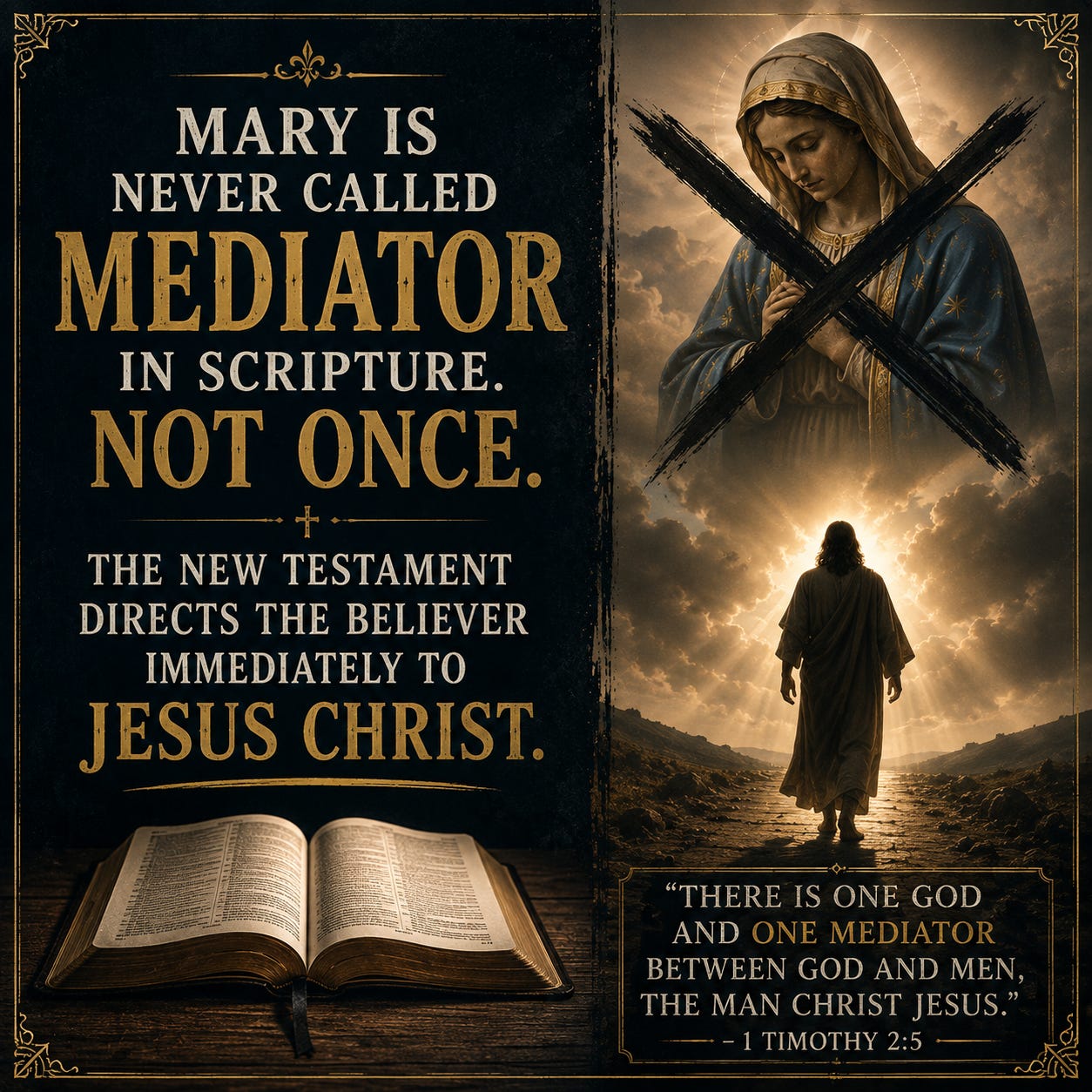
“For there is one God and one Mediator between God and men, the Man Christ Jesus.”
—1 Timothy 2:5
Paul does not present Christ as the principal mediator surrounded by lesser heavenly mediators.
He says there is one Mediator.
Jesus alone stands between God and man because Jesus alone is both fully God and fully man.
Jesus alone bore our sins.
Jesus alone shed the blood of the covenant.
Jesus alone rose from the dead.
Jesus alone entered the heavenly sanctuary as our Great High Priest.
Jesus alone is the Mediator of the new covenant.
“He is also Mediator of a better covenant.”
—Hebrews 8:6
“He is the Mediator of the new covenant.”
—Hebrews 9:15
“Jesus the Mediator of the new covenant.”
—Hebrews 12:24
Mary is never called mediator in Scripture.
Not once.
Rome answers that Mary’s mediation is subordinate to Christ’s. Yet the New Testament does not establish a hierarchy of heavenly mediators. It directs the believer immediately to Jesus Christ.
“Therefore He is also able to save to the uttermost those who come to God through Him.”
—Hebrews 7:25
We come to God through Him.
Christ does not require His mother to make Him more approachable.
2. Rome Calls Mary Our Advocate
The title Advocate is especially serious because Scripture already tells us who our heavenly Advocate is:
“And if anyone sins, we have an Advocate with the Father, Jesus Christ the righteous.”
—1 John 2:1
The apostle John does not say that believers have Jesus as their supreme Advocate and Mary as a maternal advocate beneath Him.
He says:
“We have an Advocate with the Father, Jesus Christ the righteous.”
Christ’s advocacy is grounded in His atoning sacrifice:
“And He Himself is the propitiation for our sins.”
—1 John 2:2
Mary did not make propitiation for sin.
Mary did not bear the wrath of God.
Mary did not enter heaven by virtue of her own blood.
Mary cannot plead a completed atonement that she accomplished.
Jesus can.
Our Advocate is the One whose wounds purchased our redemption.
To assign Mary the title of heavenly Advocate may be explained carefully in Catholic theology, but it is unnecessary in Scripture and inevitably competes with the office expressly given to Christ.
3. Rome Teaches Christians to Address Mary in Prayer
The Catechism explains and commends the prayer:
“Holy Mary, Mother of God, pray for us sinners, now and at the hour of our death.”
It describes believers as entrusting themselves to Mary’s prayer at the present moment and at death.
Catholic defenders often say, “We do not pray to Mary as God. We merely ask her to pray for us, just as we ask Christians on earth to pray.”
But the comparison fails.
When I ask a living believer to pray for me, I am speaking to someone physically present or contacting someone through ordinary means. Scripture plainly commands believers on earth to pray for one another.
But Scripture never instructs Christians to address departed saints.
No apostle prays to Mary.
No church in the New Testament invokes Mary.
No believer in Acts asks Stephen, James, Abraham, Moses, or any departed saint for help.
No epistle teaches the practice.
The pattern of New Testament prayer is unmistakable.
We pray to the Father:
“Our Father in heaven…”
—Matthew 6:9
We come through the Son:
“Whatever you ask the Father in My name He may give you.”
—John 15:16
We pray in the Spirit:
“Praying always with all prayer and supplication in the Spirit.”
—Ephesians 6:18
And we approach God directly because of Christ:
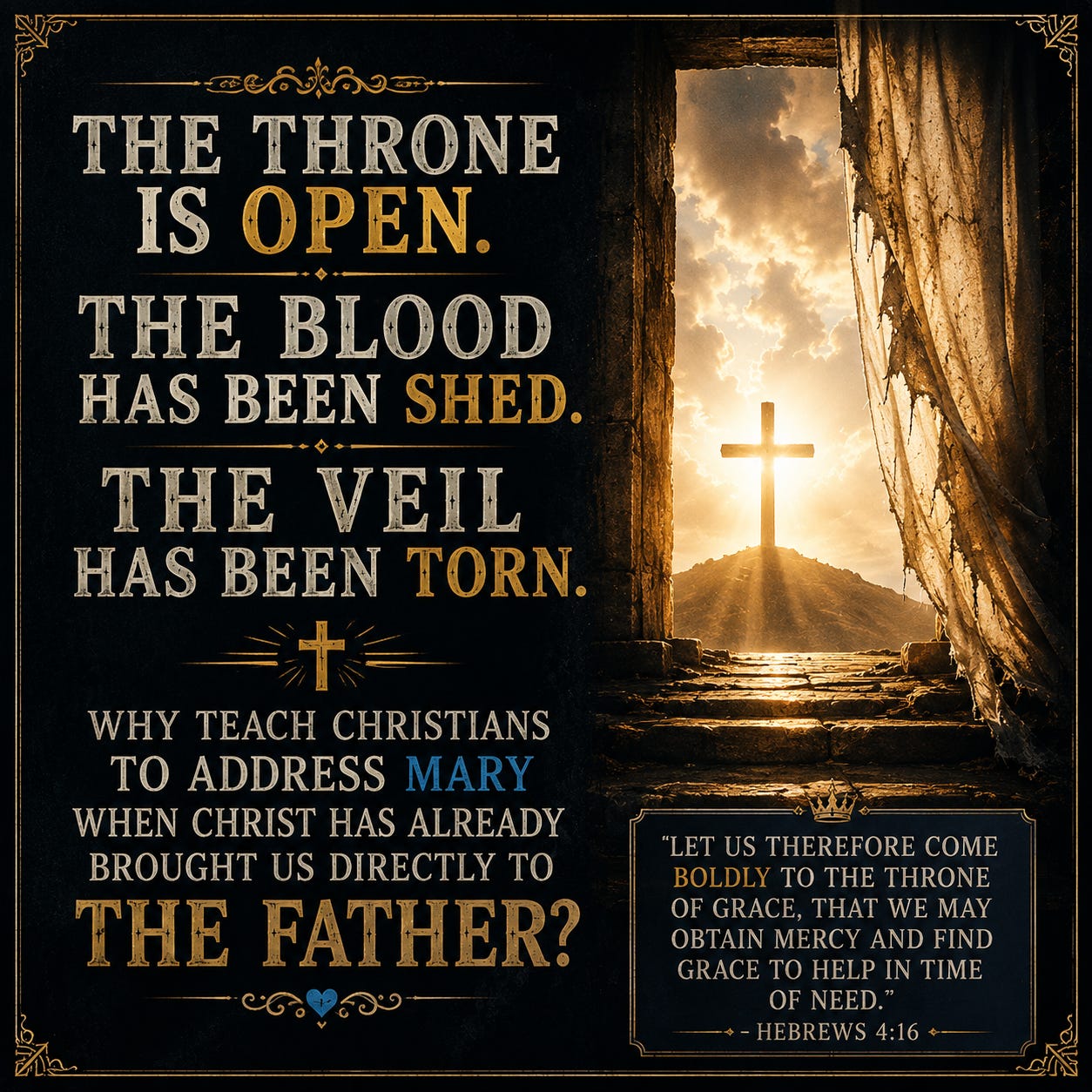
“Let us therefore come boldly to the throne of grace.”
—Hebrews 4:16
The throne is open.
The blood has been shed.
The veil has been torn.
The believer has access.
Why teach Christians to address Mary when Christ has already brought us directly to the Father?
4. Rome Calls Mary “Queen”
Marian devotion regularly addresses Mary as Queen, including the traditional prayer:
“Hail, holy Queen, mother of mercy, our life, our sweetness, and our hope.”
That prayer appears on an official Vatican devotional page alongside the teaching of Vatican II concerning Mary’s subordinate maternal role.
Consider the weight of those words:
our life
our sweetness
our hope
most gracious advocate
The Catholic apologist may provide theological qualifications for each phrase. But the ordinary Christian reading the New Testament encounters very different language.
Jesus is our life:
“When Christ who is our life appears…”
—Colossians 3:4
Jesus is our hope:
“The Lord Jesus Christ, our hope.”
—1 Timothy 1:1
Jesus is our Advocate:
“We have an Advocate with the Father, Jesus Christ the righteous.”
—1 John 2:1
Jesus is King:
“KING OF KINGS AND LORD OF LORDS.”
—Revelation 19:16
Scripture never teaches believers to hail Mary as their life, hope, or heavenly Queen.
Mary herself never claimed such titles.
She called herself:
“the maidservant of the Lord.”
—Luke 1:38
The woman of Scripture is humble, faithful, and blessed.
The Queen of the developed Marian system is surrounded by titles that the New Testament gives to Christ.
That is not a small difference.
5. Rome Attributes an Ongoing Maternal Influence to Mary
The Catechism teaches that Mary’s motherhood in the order of grace continues and that her “salutary influence” accompanies believers.
John Paul II wrote that Mary’s motherhood “continues unceasingly in the Church” as an interceding mediation.
Again, Catholic theology insists that this influence depends entirely upon Christ.
But Scripture never tells the Church that it lives beneath Mary’s continuing maternal government.
Jesus promised the Holy Spirit:
“He will guide you into all truth.”
—John 16:13
Jesus promised His own presence:
“I am with you always, even to the end of the age.”
—Matthew 28:20
Jesus is the Shepherd of the Church:
“I am the good shepherd.”
—John 10:11
Jesus is the Head of the Church:
“He is the head of the body, the church.”
—Colossians 1:18
The Holy Spirit indwells the believer.
Christ intercedes for the believer.
The Father adopts the believer.
Nowhere does the New Testament teach that Mary exercises an unseen maternal influence over the worldwide Church.
That doctrine does not arise from the apostolic text.
It must be brought to the text from later tradition.
6. Rome Has Gone Beyond What Scripture Says About Mary
The New Testament teaches several glorious truths concerning Mary:
She was a virgin when Jesus was conceived.
She was favored by God.
She was blessed among women.
She believed God’s promise.
She gave birth to the incarnate Son of God.
She was present during portions of Jesus’ ministry.
She stood near the cross.
She gathered with the disciples before Pentecost.
We gladly affirm all of it.
But Rome binds the faithful to additional dogmas concerning Mary, including her immaculate conception and bodily assumption.
The problem is not merely that these beliefs are absent from explicit biblical teaching.
The deeper problem is that they arise from an authority structure in which later ecclesiastical declarations can bind the conscience where the apostles did not.
Scripture says:
“That you may learn in us not to think beyond what is written.”
—1 Corinthians 4:6
The Roman system answers that apostolic tradition exists alongside Scripture and is authoritatively interpreted by the Church.
But once that door is opened, teachings may become obligatory even though no apostle plainly taught them and no New Testament church is shown believing or practicing them.
That is how honoring Mary becomes a vast theological system.
It begins with:
“All generations will call me blessed.”
It ends with prayers, feast days, apparitions, consecrations, shrines, titles, doctrines, and appeals to a heavenly mother whose role is nowhere laid out in the apostolic writings.
7. Apparitions and Signs Cannot Establish Marian Doctrine
Many Catholics have been deeply influenced by reported Marian apparitions.
Some accounts contain calls to prayer, repentance, or devotion. Others have included language that places Mary in an alarming mediatorial position.
Recent Vatican doctrinal statements have themselves acknowledged that some Marian expressions risk attributing to Mary a place belonging uniquely to Christ. A 2024 Vatican note warned that certain uses of “mediatrix” could contradict Scripture’s teaching that Christ is the one Mediator.
A 2025 doctrinal note also cautioned that the title “Mediatrix of All Graces” could suggest that Mary distributes spiritual goods apart from the believer’s personal relationship with Christ.
That caution is revealing.
Once Marian language has grown so large that Rome itself must warn that it may obscure Christ, the danger is no longer imaginary.
But Scripture gave the Church its test long ago:
“Beloved, do not believe every spirit, but test the spirits, whether they are of God.”
—1 John 4:1
“But even if we, or an angel from heaven, preach any other gospel to you…let him be accursed.”
—Galatians 1:8
A radiant figure, supernatural sign, healing, prophecy, or apparition proves nothing by itself.
The message must be judged by the written Word of God.
Miracles do not validate truth.
Truth validates miracles.
8. Mary’s Own Testimony Points Away from Herself
The most powerful biblical answer to excessive Marian devotion comes from Mary herself.
Mary called God her Savior:
“My spirit has rejoiced in God my Savior.”
—Luke 1:47
Mary understood herself as the Lord’s servant:
“Behold the maidservant of the Lord!”
—Luke 1:38
Mary magnified the Lord:
“My soul magnifies the Lord.”
—Luke 1:46
And Mary’s final recorded words in Scripture direct attention entirely to Jesus:
“Whatever He says to you, do it.”
—John 2:5
That is the biblical Mary.
She does not draw disciples toward herself.
She points them to her Son.
She does not say:
“Come to me.”
She says:
Listen to Him.
She does not present herself as the hope of sinners.
She rejoices in God her Savior.
She does not claim the throne.
She calls herself a servant.
Mary would not recognize much of the devotional empire later built around her name.
The Mary of Scripture would tell Rome what she told the servants at Cana:
“Whatever He says to you, do it.”
9. Honor Is Not Invocation
There is a proper way to honor Mary.
We honor Mary when we believe what Scripture says about her.
We honor Mary when we recognize her courage, humility, and faith.
We honor Mary when we refuse to slander her.
We honor Mary when we call her blessed.
But we do not honor Mary by assigning her unscriptural offices.
We do not honor Mary by making her a heavenly mediator.
We do not honor Mary by calling her our life or our hope.
We do not honor Mary by addressing prayers to her.
We do not honor Mary by allowing devotion to her to eclipse the sufficiency of Christ.
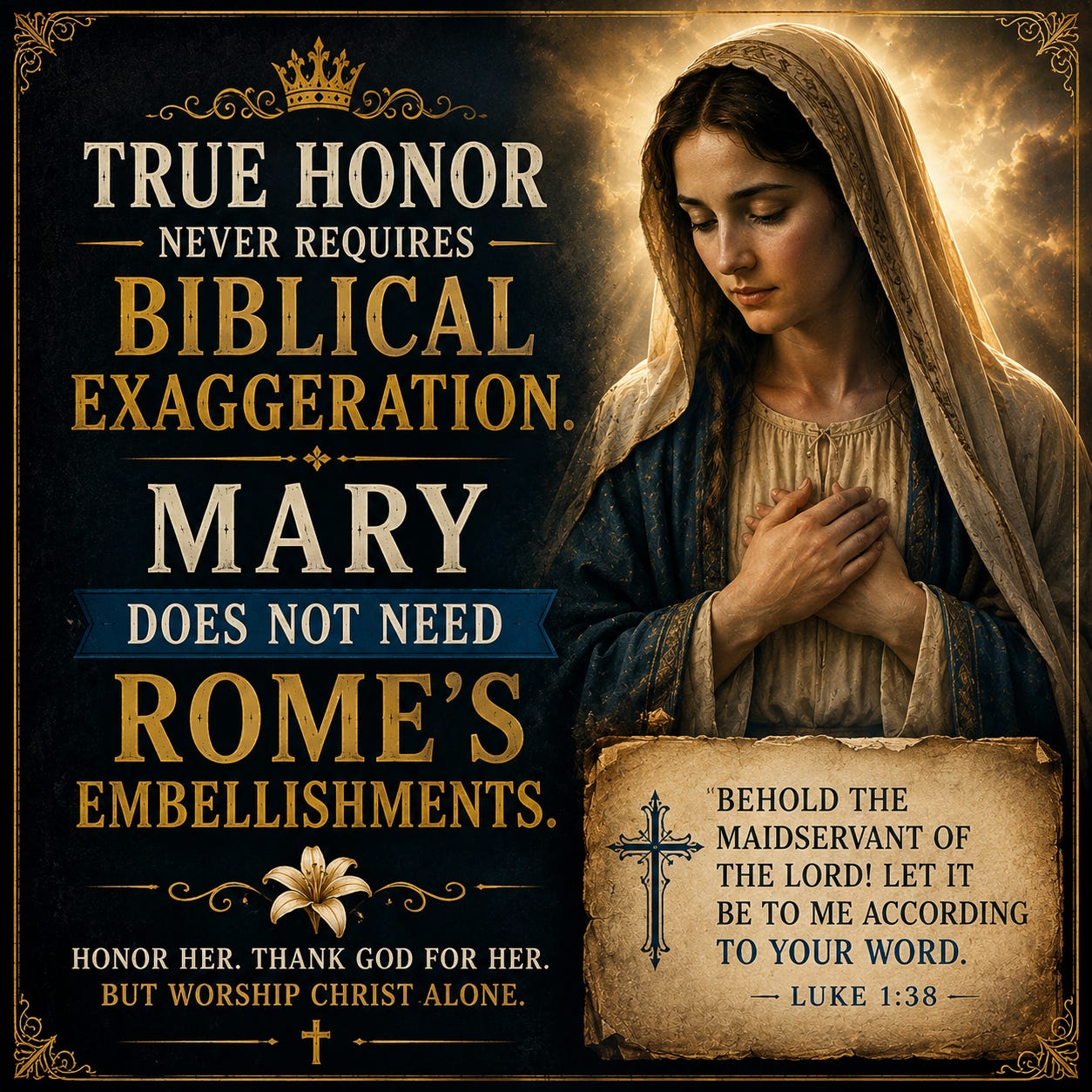
True honor never requires biblical exaggeration.
Mary does not need Rome’s embellishments.
Her place in redemptive history is already extraordinary.
But she remains a redeemed human being—a recipient of grace, not its source; a servant of the Lord, not the Church’s heavenly sovereign; the mother of Jesus according to His humanity, not an additional mediator between God and men.
Christ Is Enough
The issue is not Mary versus Jesus as though they were rivals.
Mary is not Christ’s rival.
The problem is a religious system that has placed upon Mary titles and functions Christ never gave her.
The apostles preached Christ.
They prayed through Christ.
They trusted Christ.
They proclaimed Christ as Savior, Mediator, Advocate, High Priest, Shepherd, Head, Lord, and King.
They never taught the Church to invoke Mary.
They never called her Mediatrix.
They never called her the hope of Christians.
They never entrusted the hour of their death to her.
They never placed the spiritual life of the Church beneath her maternal influence.
That system came later.
The New Testament gives us something better.
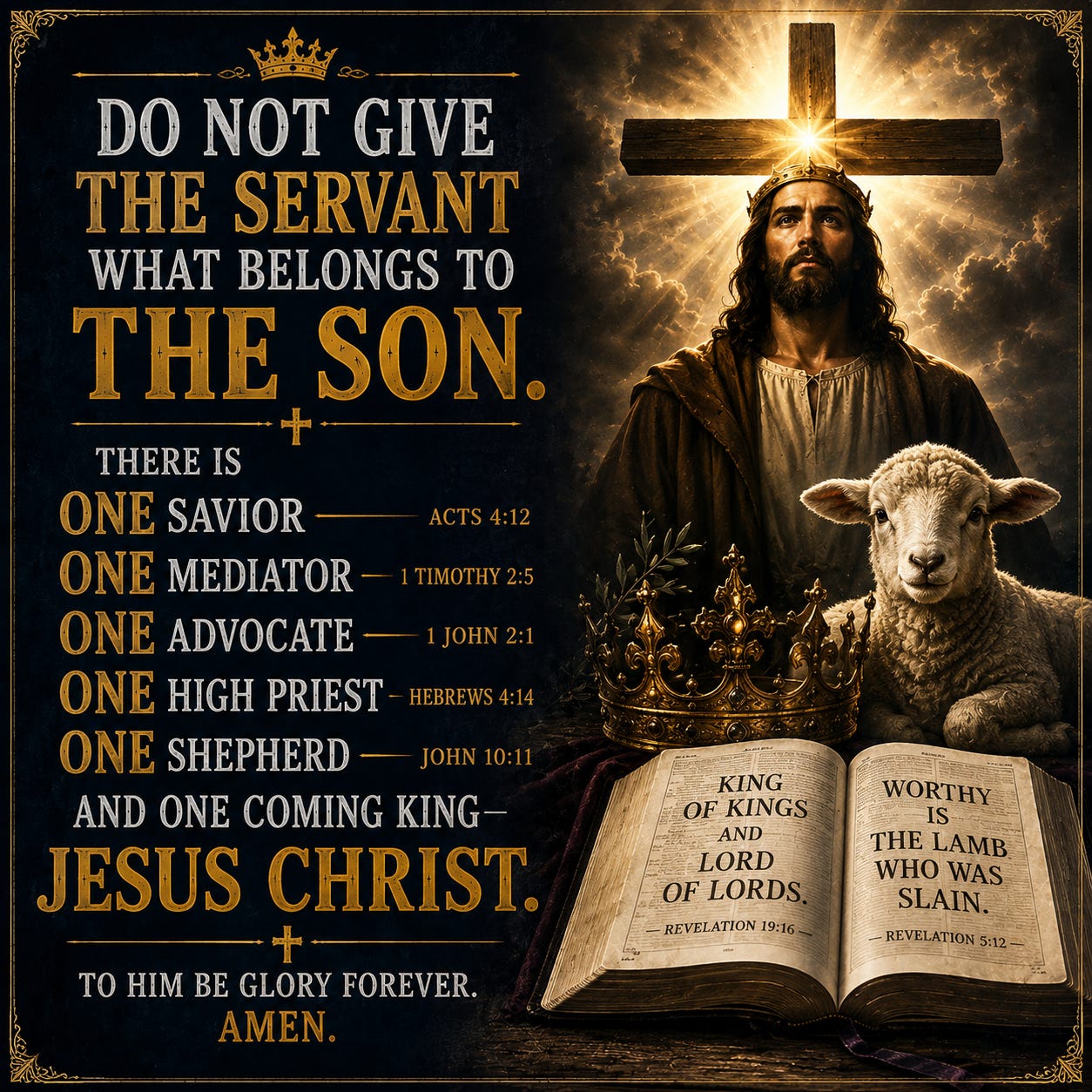
One Savior.
One Mediator.
One Advocate.
One High Priest.
One Shepherd.
One coming King.
His name is Jesus Christ.
Honor Mary as Scripture honors her.
But do not give the servant what belongs to the Son.
Do not exchange direct access to Christ for a chain of heavenly intercessors.
Do not allow religious sentiment to obscure the finished work of the cross.
The veil has been torn.
The throne of grace is open.
The Savior receives sinners.
Come directly to Him.
“Nor is there salvation in any other, for there is no other name under heaven given among men by which we must be saved.”
—Acts 4:12
Not Mary.
Not the saints.
Not Rome.
Christ alone.
Robert Rousseau
Candlefish Ministries John 1:5
“And the light shines in the darkness, and the darkness did not comprehend it.”
Wow!! That’s what I love about your work, Robert. Concise, clear and founded on scripture! Culture today is full of nonsense, confusion and deception, regarding absolute truth as nothing more than a concept or fantasy contrived by ancient philosophy. What Boulderdash!!
Your teachings have proved to be most useful and have answered so many of my questions, for that I am grateful! We will continue to pray for you and your brilliant work to reach those who need to hear about the love of Jesus and the truth of the gospel!
Keep Praising The Lion Of Judah! 😇
Thanks again!
Mary put a name on Isaiah 7:14 and admitted she was a sinner.